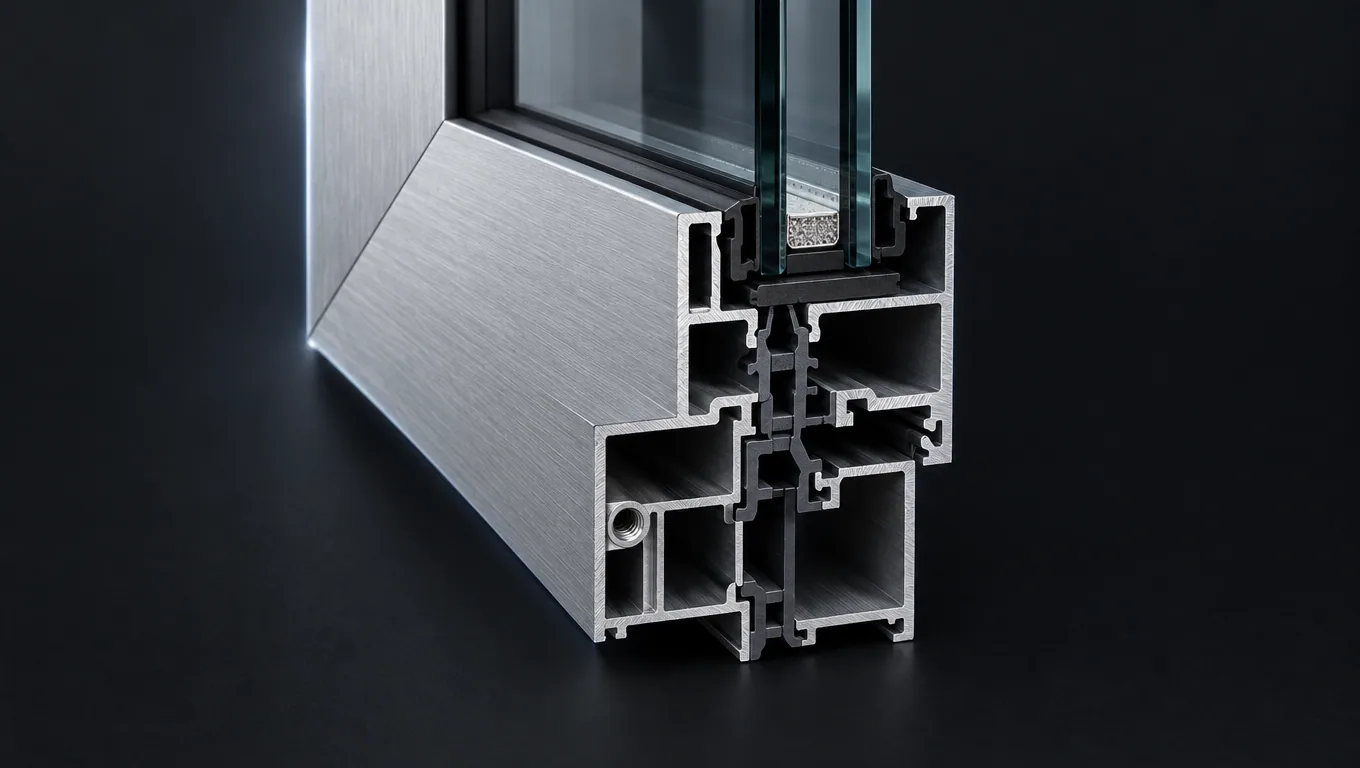
Working with an aluminum door supplier for the first time is less about finding the lowest quote and more about understanding the chain that turns your inquiry into a loaded container. A serious aluminum door supplier runs a predictable sequence — shop drawings frozen, profiles extruded, finishes applied, doors assembled and glazed, then inspected, packed and shipped on agreed terms — and can show you where your order sits in that sequence at any point. This guide walks importers and distributors through each stage: how lead time is actually built (and why responsible manufacturers quote it as 25–45 days after drawing freeze and deposit rather than a single promise), why MOQ exists and where it flexes, what EXW, FOB and CIF really divide between seller and buyer, and how a pre-loading inspection plus a clean document pack protects what you paid for.
Most importing problems are not factory quality problems but sequencing problems: drawings approved late, a finish changed after extrusion started, a vessel booked before the cargo was ready, or paperwork that does not match the cargo inside. All of them are avoidable, and the rest of this article shows how.
From Inquiry to Delivered Container: The Export Chain at a Glance
Whether you are a distributor stocking a standard range or a contractor sourcing a specific project, the path from first contact to cargo at your port follows the same seven stages — a dealer ordering repeats moves fast because drawings and dies already exist, while a project buyer goes through the engineering stages in more depth, but the order does not change.
| Stage | What happens | Your job as the buyer |
|---|---|---|
| 1. Inquiry | You send openings, quantities, target performance and market; the supplier checks feasibility and price level. | Give real dimensions and quantities; vague inputs produce vague quotes. |
| 2. Quotation | Itemized offer by series, finish, glass and quantity, with lead time and trade terms stated. | Confirm what is included — hardware, glass, packing — before comparing prices. |
| 3. Shop drawings | The supplier converts your openings into fabrication drawings for every unit. | Review and freeze the drawings; this is the point of no return for changes. |
| 4. Deposit and production | Extrusion, finishing, machining, glazing and assembly run against frozen drawings. | Agree on an inspection checkpoint and keep changes out of the pipe. |
| 5. Pre-loading inspection | Finished units are sampled, checked and photographed before packing. | Attend in person, send a third-party inspector, or rely on agreed photo/video evidence. |
| 6. Container loading and shipping | Goods packed, container stuffed, documents issued, vessel sails. | Track the booking and confirm the document set matches the contract. |
| 7. Arrival and customs | You clear the shipment at destination and receive the cargo. | Check the cartons against the packing list at the earliest chance. |
Two things decide whether this chain runs smoothly. The first is how early the drawings are frozen, because everything downstream — extrusion dies, finish batches, glass orders, hardware procurement — keys off that document. The second is which Incoterm you agreed, because it decides who books the freight, who insures it and at exactly which moment the risk becomes yours. The next four sections take these stages one at a time.
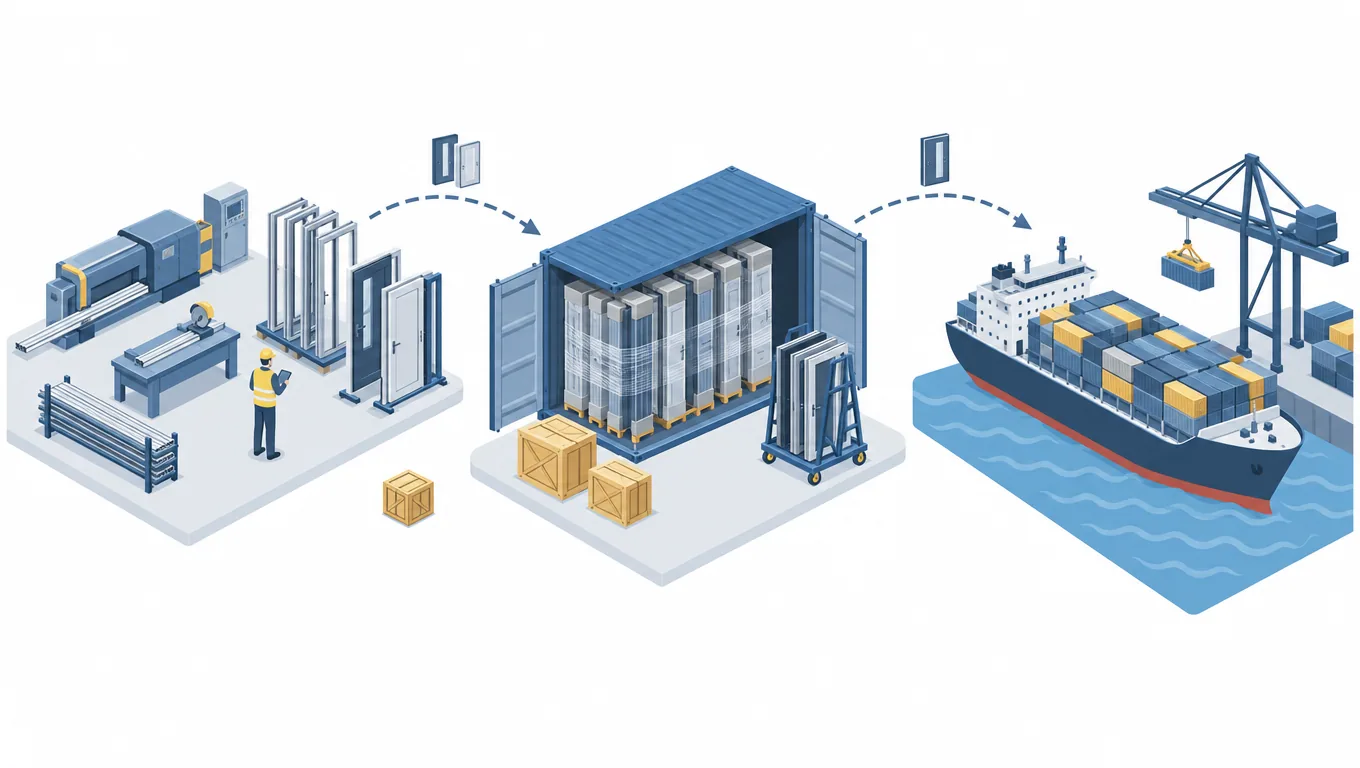
Lead Time With an Aluminum Door Supplier: Where the Days Actually Go
A common first-time mistake is to treat quoted lead time as one block of waiting. It is not. It is a stack of sequential operations, each with its own logic, and each capable of stretching if an input is late. Understanding the stack is what lets you judge whether a lead time is realistic — and what to challenge.
On our own product pages the number is stated the way serious manufacturers state it: production typically runs 25–45 days after drawing freeze and deposit, confirmed per order in the quotation, with complex glass, special colors or peak season pushing toward the upper end. The range is the realistic span across the stages below.
Drawing freeze: the real start of the clock
Nothing meaningful happens in production until the shop drawings are approved. The supplier converts architectural openings into unit-by-unit fabrication drawings — frame sections, hardware positions, glass sizes, opening directions. Until you sign those off, no die is ordered, no profile is extruded and no glass is cut. In practice, the review round-trip is often where importers lose more days than in any factory operation, because every question back to the site ("is this opening measured with or without the screed?") stalls the whole queue. Freeze them quickly and completely: a change after freeze does not just add rework time, it can invalidate already-extruded material.
Profile extrusion: existing die or new die
Aluminum door frames start as billets pushed through steel dies. If your order uses a system the factory already runs — the case for standard hinged, sliding and pivot ranges — extrusion is a scheduled run against an existing die, and the operation typically takes days, not weeks. If your project needs a brand-new profile, a die must be cut and sampled first, and that adds development time and usually a die charge, which is one of the structural reasons MOQ exists (more on that below). This is also why a stock-oriented buyer should favor standard systems: our aluminum sliding door series and hinged ranges run on established dies, a quiet but decisive lead-time advantage over bespoke profiles.
Surface finishing: the batch business
Extruded profiles are bare metal; they leave the plant only after finishing — powder coating, anodizing or wood-grain transfer. Finishing is a batch process: profiles are racked, treated and cured together, and a color change on a coating line involves purging the line. If your color is already in the factory's running schedule, your profiles join a batch; if it is a special color, your order may wait for enough linear meters to justify a run, or for a scheduled changeover. Special finishes are therefore the most common reason an order drifts from 30 days toward the 45-day end of the range. Lock your finish color at quotation stage, not after production starts.
Machining, glazing and assembly
Once finished profiles are back, fabrication is comparatively fast and controllable: cutting to length, machining hardware recesses, assembling frames and leaves, glazing, fitting hardware. This is where quality is visibly made or lost, which is why your inspection (covered below) samples it. Assembly time scales with unit count and complexity — single-leaf hinged doors assemble faster than large sliding panels with multi-point locks — but for most orders this stage runs in days within the quoted range.
Vessel booking and ocean transit
Here is the trap that catches new importers: the 25–45 day figure is production, not delivery. Ocean transit adds its own time depending on destination and sailing frequency, and schedules around major holidays can compress space and push bookings. Plan your landed date as production plus transit plus customs clearance, and ask the supplier to confirm the earliest realistic vessel rather than assuming same-week departure. When you promise dates to your own customers, quote from the confirmation on the sales contract — the only number actually committed.
| Stage | What drives its duration | What typically stretches it |
|---|---|---|
| Drawing freeze | Review speed on your side | Unanswered site questions; late dimension changes |
| Extrusion | Existing vs new die; production queue | New profiles; peak-season capacity |
| Finishing | Batch scheduling; color changeovers | Special colors; small quantities of many colors |
| Glazing and assembly | Unit count and hardware complexity | Multi-point locks; oversized panels |
| Booking and transit | Destination and sailing schedule | Holiday space crunches; port congestion |
MOQ: Why It Exists and Where It Flexes
Minimum order quantities are not arbitrary gatekeeping. Every MOQ in the aluminum door business traces back to a real cost floor, and understanding those floors tells you where a supplier can flex and where they mathematically cannot.
The die: why custom profiles carry minimums
A new extrusion die is a tooling investment: cut, heat-treated, sampled and corrected before the first commercial profile comes off it. A bespoke profile for a few hundred kilograms of material spreads that cost over too little aluminum to make sense for either side — that is why custom-profile MOQ exists. The flip side matters just as much: standard system profiles carry no die cost because the die already exists and has run for years. A dealer stocking standard ranges bypasses the most expensive part of the MOQ equation, and the same logic applies to hardware and gaskets already qualified on those systems.
Finishing batches: why one door in a special color is not realistic
The second driver is the finishing line. Powder coating and anodizing are batch processes with real setup costs — purging between colors, rack minimums, bath maintenance regardless of output. A line cannot economically stop for one door in a custom shade, so small orders in unusual finishes either wait for a scheduled changeover or carry a surcharge that reflects batch reality. Standard stocked colors ride normal running batches, which is why they move fastest.
Dealer orders versus project orders: where the flexibility lives
MOQ behaves differently for the two buyer types this guide addresses:
Dealers ordering from an established range get the most flexibility, because profiles, finishes, glass and hardware all sit inside existing production flows. Mixed-container orders — several sizes of one series across configurations — are the natural unit of trade, and repeats run faster still because drawings, dies and finish schedules are on file. If you are building a local business around aluminum entry doors, our aluminum entry door range is typical of a stockable series, and our dealer program sets repeat-order quantities, pricing tiers and marketing support for that model.
Project buyers face MOQ differently: the project defines the quantity, so the question is not "can I order less" but "can my specification stay inside economical production". It almost always can — choose door systems from standard series and confine customization to sizes, configurations and glazing rather than new profiles or exotic finishes. A commercial door supplier bidding tenders learns this early: the winning specification usually reads custom to the architect but runs standard in the factory.
Incoterms for Door Imports: EXW, FOB and CIF in Practice
Incoterms decide who does what — and who carries the risk — at each point between the factory and your port. Three terms cover most aluminum door shipments, and choosing is simpler than it looks once you see the split. The descriptions below follow the current Incoterms rules; your contract should reference the rules and named place explicitly (for example, "FOB [named Chinese port], Incoterms 2020").
| Responsibility | EXW (Ex Works) | FOB (Free on Board) | CIF (Cost, Insurance, Freight) |
|---|---|---|---|
| Goods made available | At seller's premises | On board the vessel | On board the vessel |
| Export clearance | Buyer | Seller | Seller |
| Main carriage booking | Buyer | Buyer | Seller |
| Insurance | Buyer | Buyer | Seller (minimum cover) |
| Risk transfers to buyer | When goods are placed at buyer's disposal at the factory | When goods are on board at the port of loading | When goods are on board — same as FOB, despite cost differences |
| Import clearance and duties | Buyer | Buyer | Buyer |
Three practical notes for door cargo. First, the FOB/CIF risk point surprises buyers: under CIF the seller pays freight and insurance, but risk still transfers when goods go on board at the origin port. If a container is damaged at sea, a CIF buyer claims on the insurance policy, not against the seller — check whose policy applies and what cover level it carries. Second, when a door supplier in China quotes EXW, you or your forwarder must handle export clearance in a country whose procedures you may not know; first-time importers should almost always start at FOB. Third, doors and glass are dense and heavy for their volume, so agree the loading plan (units per container, container type) before comparing CIF and FOB offers — a cheap CIF quote with a badly planned load can cost more at destination than a well-planned FOB one.
Whichever term you choose, the common payment structure — a deposit to start production, balance before shipment, exact percentages per contract — belongs on the same contract as the Incoterm, because the balance trigger needs the reference point the term provides.
QC Before Loading: AQL Inspection and the Export Document Pack
By the time a container of doors is sealed, fixing anything is economically brutal. A defect found at your warehouse means return freight, customs complications and a disappointed project; the same defect found before loading means a replacement made inside the production schedule. That asymmetry is why pre-loading inspection deserves the same seriousness as price negotiation.
AQL sampling: the vocabulary of pre-shipment inspection
Professional pre-shipment inspections are built on acceptance sampling per ISO 2859-1 (ANSI/ASQ Z1.4 in the US). You do not inspect every unit; you inspect a statistically defined sample sized to the lot, and accept or reject the lot on the defects found. AQL — acceptable quality limit — is the defect rate the plan is designed to catch. Buyers commonly set 2.5 for major defects and 4.0 for minor, with critical defects (safety hazards, wrong glass, non-functioning locks) at zero tolerance. A door that fails to lock is not a minor statistic; the unit is replaced and re-inspected.
For doors, the checklist concentrates on what a factory can get wrong and a container ride cannot fix: dimensions of frames and leaves against approved drawings; finish (color against the approved sample, adhesion, scratches); hardware operation — locking, handles, closers, hinge alignment; glazing — correct glass as ordered, gasket seating, no damage; packing — protective film, corner protection, carton marking against the packing list. Insist the inspection happens before container stuffing, and define the evidence: photos per item code, a checklist against drawing numbers, sample measurements recorded.
Three realistic options: your own person on site, a third-party inspection agency for a man-day, or the supplier's internal final inspection with documented results. For a first order from a new factory the first two pay for themselves; for a repeat dealer order in a proven range, documented internal inspection with photos is proportionate. Agree whichever you choose in the contract — an inspection right not written down is not an inspection right.
The document pack: papers that must match the cargo
The second half of export QC is paperwork. A door that passed inspection is still stranded at destination if its documents do not clear customs. The core set for a typical shipment:
- Commercial invoice (CI) — customs assesses duty against it; descriptions, quantities and values must match the contract and the cargo.
- Packing list — what is in which carton and container; your warehouse checks against it on arrival, so it must reflect actual stuffing, not the plan.
- Certificate of origin (CO) — declares where goods were produced; often required for clearance and, under trade agreements, for preferential duty. Ask your broker whether your market needs a preferential form or consular legalization — requirements vary by destination and take time, so flag them before production, not at loading.
- Bill of lading (B/L) — issued by the carrier for the sea leg; you need it to take delivery, with consignee and notify party exactly as your broker expects.
Two habits keep the pack out of trouble. First, send the exact consignee, notify party and description conventions your broker uses before the invoice is issued — descriptions that differ from your previous imports invite queries. Second, reconcile the set: invoice, packing list, CO and B/L must tell one story of quantities, weights and descriptions. Document mismatches are the most common avoidable cause of customs delays, and always cheaper to fix before the vessel sails.
How to Evaluate an Export Door Supplier Before the First Purchase Order
Everything above assumes the factory on the other end of the email can actually run the chain described. For an importer choosing among export door supplier options, a structured evaluation beats a gut feeling. The checks that matter:
Engineering depth. Ask for a sample shop drawing set for a product like yours. A capable commercial door supplier produces fabrication drawings with section details, hardware schedules and glass specs — documents you can hand your installer. A trading company without factory depth usually cannot, and the gap shows the first time a technical question needs an answer in hours, not days.
Finishing control. Finishing is where door quality is most visible and most often compromised. Ask which processes run in-house and which are subcontracted, and request samples against a stated color standard. A beautiful profile with a poor coating fails in the field within a couple of years.
Compliance evidence. Whatever your market requires — performance testing, material standards, management-system certification — judge it from documented evidence, not adjectives. Our own claims are published on our certifications page, and any supplier you evaluate should offer the equivalent.
Communication cadence. The best predictor of a smooth order is behavior between quotation and deposit: do answers arrive with drawings attached, do they flag what is unclear instead of guessing, do they state lead time as a conditioned range rather than one attractive number? A door supplier in China who says "45 days because your special color needs a dedicated coating run" beats one who promises 30 and delivers 60.
References in your market. Ask for export references in destinations with comparable climates and codes — not client names, but evidence they ship routinely to ports like yours and know your customs regime's document conventions.
Run all five checks before the first purchase order, and the chain described in this guide — frozen drawings, realistic 25–45 day production, an honest MOQ conversation, the right Incoterm, an inspection you defined and a document pack that matches the cargo — stops being a list of risks and becomes your standard operating procedure.
Frequently Asked Questions
What lead time should I promise my own customers when reselling?
Build the promise in layers: production runs 25–45 days from drawing freeze and deposit, as confirmed on your quotation, then add ocean transit and customs clearance. Repeat orders in a standard range shorten the front end because drawings and finishes are on file — but always quote from the lead time on the current sales contract, not a figure remembered from a previous order.
Can I order below the stated MOQ?
Sometimes — it depends on why the MOQ exists. Standard series with existing dies, stocked finishes and qualified hardware can often be mixed into smaller dealer orders; that flexibility is exactly what the dealer program is built around. Custom profiles and special finishes are the two areas where going below minimum is not realistic — die amortization and finishing batch sizes are production economics, not negotiable policy.
Which Incoterm should a first-time importer choose?
FOB at a named origin port is the usual right answer: the seller handles export clearance from a country whose procedures they know, you control the freight forwarder and the main carriage cost, and risk transfers at a clear, inspectable point — goods on board. CIF is convenient but hides freight and insurance quality inside the seller's price, and EXW leaves export clearance with you, which is difficult without local experience. Whichever you choose, name the place and the Incoterms edition on the contract.
What documents should arrive with my shipment, and who prepares them?
The core pack is the commercial invoice, packing list, certificate of origin and bill of lading, prepared by the supplier and the carrier. Feed accurate consignee and notify-party details before issuance, flag early if your market requires a preferential origin certificate or consular legalization, and reconcile the set — quantities, weights, descriptions — against the contract before the goods sail. Your receiving team works from the packing list, so insist it reflects actual stuffing.