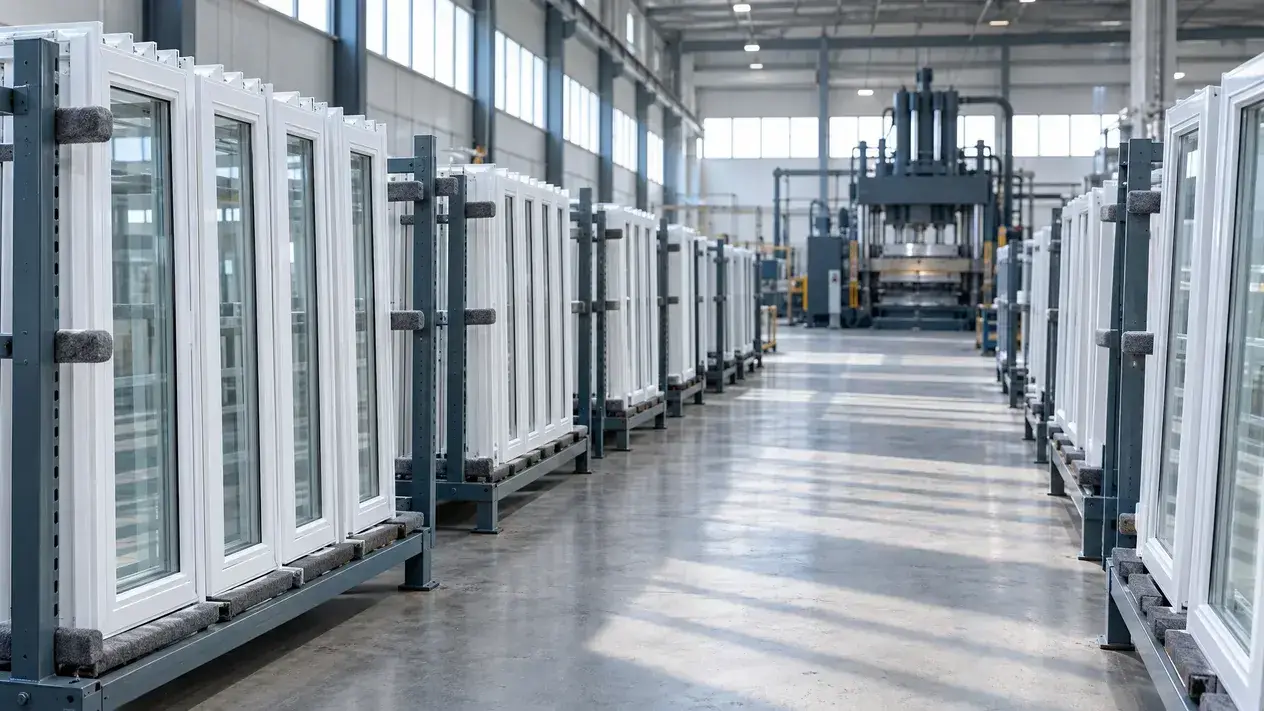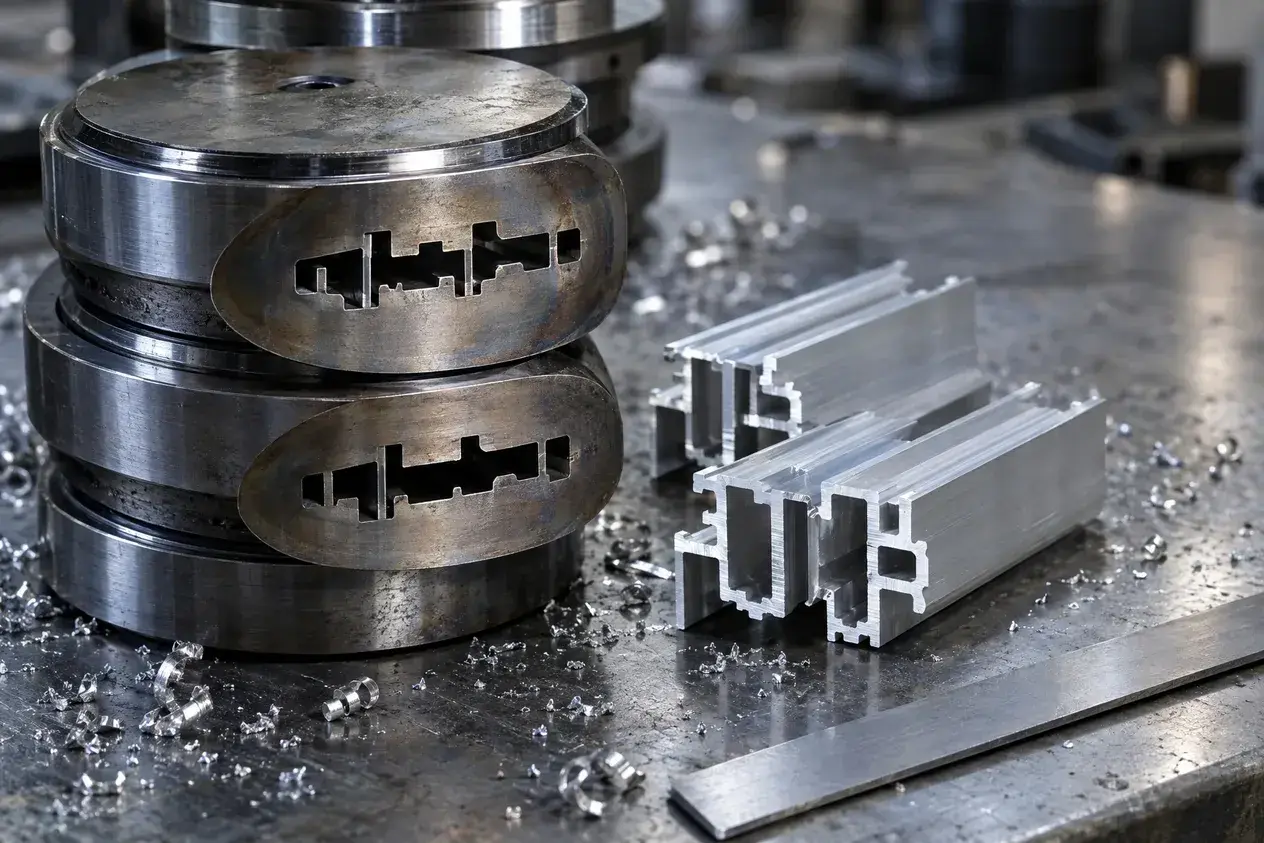
A real aluminum window factory in China is not proven by a website or a certificate scan. Verifying a Chinese aluminum window supplier comes down to three checks a buyer can run before money moves: a legal entity whose name, Unified Social Credit Code and bank account all match; a plant that actually cuts, machines, assembles, glazes and inspects the product being quoted; and test evidence whose holder, edition and series scope match the quotation. Chinese suppliers fall into four groups — profile extruders, fabricators, assemblers and trading companies — and each proves a different capability. This guide turns those checks into an audit a buyer can run in one site visit or one scheduled video call: document verification, line inspection, QC records, certificate lookups, third-party inspection and a weighted scorecard that decides whether to pay a deposit, re-audit or walk away.
What a Real Aluminum Window Factory Has to Prove
The word “factory” in a Chinese company name carries no legal meaning. What matters is which stages sit inside the same entity and site. Suppliers sort into four groups:
- Profile extruders own the press, dies and billet. They prove alloy, temper and wall thickness, but many sell profile only.
- Fabricators cut, machine, insert the thermal strip, crimp corners, glaze and assemble. This is the group a window buyer needs, whether or not it extrudes.
- Assemblers buy finished profiles and build frames, often outsourcing surface treatment and glass.
- Trading companies own no plant. They can deliver, but you buy their supplier’s capacity and quality system.
The common mistake is treating “no extrusion press” as proof of a trading company. A fabricator that buys profile is a normal window factory; an extruder that outsources fabrication is not a window factory. Ask per process: where is this step done, who does it, where is the record? For the stages we run in-house, see the aluminum window systems we manufacture.
Start With the Legal Entity: License, USCC and Bank Account
To verify a Chinese supplier, three documents must name the same company before technical talk starts: the business license, the seller on the contract or proforma invoice, and the bank account receiving the deposit. A mismatch means the entity you vetted is not the entity you are paying.
| Document | What to check | What a mismatch means |
|---|---|---|
| Business license | Registered name, 18-digit USCC, address, scope covering production | The seller may be a trading entity, or the scope may omit production |
| Contract or proforma invoice | Seller name identical to the license, same USCC where shown | You are contracting with a company you did not vet |
| Bank account | Account holder identical to the license; corporate, not personal | Money leaves the audited entity, and recovery gets harder |
Read the license for the registered name, the 18-character Unified Social Credit Code (USCC), the address and the business scope. A scope limited to sales or trade, with no production item, tells you the signing entity does not make windows.
Search the USCC in the National Enterprise Credit Information Publicity System, or a commercial database: active status, incorporation year, address, penalties. If you cannot search it, commission a company search report or ask for a stamped license copy and a bank account opening certificate.
Factory or Trading Company? Signals From the Plant Itself
Five signals separate a plant from an office with good photographs. None is conclusive alone.
- Address match. Registered address, plant gate and loading address should be one place. Trading companies call a partner plant “our factory” until you ask for the lease.
- Who walks you. A process engineer answers on dies, wall thickness, strip insertion and curing temperature. A salesperson who cannot is a weak signal, not a verdict.
- Physical evidence. Profile racks sorted by series and color, die racks, offcuts, work-in-progress carts, coating jigs and glass racks. An office has none.
- Shipping entity. Ask who appears as shipper on the bill of lading and whether the customs declaration runs under the factory or a trading company.
- Capacity coherence. Shifts and daily output per line against your order quantity. If the numbers do not reconcile, write it down and keep walking.
Once the type is clear, compare the plant against a shortlist of Chinese aluminum window manufacturers for contractors.
What to Inspect on the Line, and How to Audit Remotely

A line visit is not a tour of machines. Five stages carry the evidence.
The five stages to watch
- Incoming profile and extrusion. Measure wall thickness against the series: 1.2–1.4 mm for economy profiles, 1.8–2.0 mm for structural. Confirm alloy grade and temper, and read the ink-jet code on the profile end against its batch sheet.
- Surface treatment. Powder coating: pretreatment tanks, curing oven, film thickness gauge. Anodizing: bath and jigs. Establish whether it is in-house; if outsourced, ask for the subcontractor’s records.
- Thermal strip and machining. PA66 GF25 strip, knurling before insertion, CNC cutting, drainage milling, corner crimping or injection.
- Glass and sealing. Spacer, butyl or PIB primary seal, two-part sealant, argon fill. Look at the glass rack and assembly station, not the showroom sample.
- Final assembly and adjustment. Hardware, operating force, gasket compression, sash alignment and surface protection before packing.
A remote walkthrough that resists editing
Ask for a continuous live video call, not a promotional film. Direct it: name a station at random and ask the camera to read the work order, the machine nameplate, today’s date and the factory gate sign in one unbroken walk. Record the screen. Red flags: showroom only, edited video only, refusal to go live, and bad-signal cutaways when you name a station.
QC Gates, Test Equipment and the Records Behind Them
Quality control is three gates, not one final check. Ask what is measured at each.
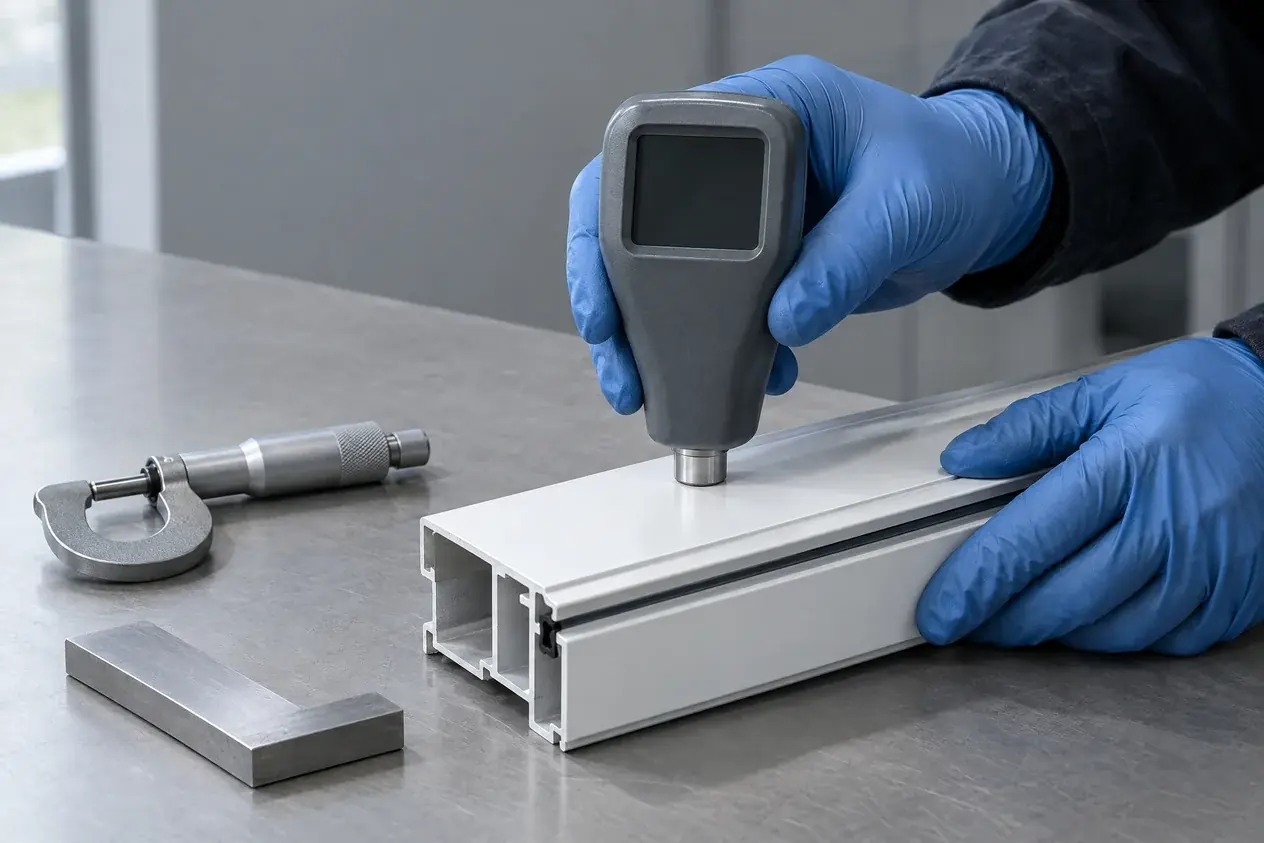
- Incoming: wall thickness, film thickness, hardness and color against the batch.
- In process: cut length, frame diagonal, corner strength and sealant injection, checked per work order rather than per shift.
- Final: operating force, hardware function, gasket seal and a water or air spot check on sampled units.
Each gate should leave a record: an incoming sheet tied to the profile batch, a patrol record per work order, and a final sheet with measured values.
Equipment matters less than whether it is used. A film thickness gauge, micrometer, square and water spray rack cover standard window work; each should carry a calibration label and a recent record.
Test the records rather than reading them. Pick three recent work orders and ask for the incoming, in-process, final and packing records for each. A record counts only when it traces to a batch and carries a signature. Every line ticked, all in the week of your visit, is worse than a missing sheet.
Certificate Verification: Holder, Scope, Edition and Database
A certificate is evidence of a specific claim, not of the company behind it. Read four fields.
- Holder. Issued to the entity that signs the contract and makes the product, or to an affiliate, brand or trading company?
- Standard and edition. EN 14351-1 for European windows, NFRC 102 for US ratings, ISO 9001:2015 for quality systems. A withdrawn edition is not current evidence.
- Series or model scope. A product certificate covers what was tested, not the catalogue.
- Validity and issuer. Check the expiry date and whether the issuing body is accredited for that scheme.
Check the database, not the image. A CE mark needs a Declaration of Performance and the test report behind it. An NFRC rating is looked up in the Certified Products Directory. An ISO 9001 certificate should resolve on the issuer’s register under CNAS or IAF accreditation.
The certificate set Aoslon publishes, with number and series scope shows the format to demand: standard, reference, covered series, issuer and validity, with a note that the certificates are issued to the manufacturing entity, not the brand. One CE certificate covers a single aluminum sliding door type, which is normal and the reason the scope line matters.
Australian and New Zealand projects typically ask for AS 2047 evidence; North American projects for NAFS/AAMA evidence. Request both per series; a CE or ISO 9001 certificate substitutes for neither.
Third-Party Inspection: Appointing the Inspector and Setting AQL
The common mistake is buying the wrong service. There are three, and they answer different questions.

- Factory audit. Before the deposit: can this entity and this plant make what is quoted?
- During-production inspection. While the order runs: is the work being built to the approved sample and drawing?
- Pre-shipment inspection. Before loading: is this batch complete, to specification and packed correctly? It inspects goods, not the factory.
Commission it yourself: the buyer orders, pays and receives the report directly. When the supplier pays or forwards it, independence is reduced.
Write the scope letter first: which workshops and records are in scope, the sample size and sampling standard (ISO 2859-1 or ANSI/ASQ Z1.4), the inspection level and the AQL values. Set those values yourself and agree the numbers in writing; require photographs, a nonconformity list and a corrective-action section.
Know the limits. An inspector sees the plant on one day and the documents it produces; the report is not a quality assurance for the order. Passing an audit does not mean the first shipment will be right. Fees are quoted by person-day and location; ask the inspection company.
Scoring the Audit and What to Do If It Fails
Observations become a decision only when weighted. Score each line from zero to its full weight.
| # | Check | Weight |
|---|---|---|
| 1 | Entity alignment: license, contract and bank account | 15 |
| 2 | Plant address matches the license and the lease | 10 |
| 3 | Key stages in-house: cutting, machining, strip insertion, corner assembly, sealing | 20 |
| 4 | Surface treatment in-house, or outsourced with records | 10 |
| 5 | Three QC gates with records traceable to a work order | 15 |
| 6 | Test equipment in use and calibrated | 5 |
| 7 | Certificate holder, scope and database check | 10 |
| 8 | Capacity and lead time consistent with your order | 10 |
| 9 | Export documentation: shipper, declaration, packing | 5 |
Read the total as a gate, not a grade: 80 or above, proceed; 60 to 79, conditional with written corrective actions and a re-audit; below 60, walk away. Any veto overrides the score: entity or account mismatch, refusal of a third-party audit, no verifiable certificate, an unexplained address mismatch, or payment to a private account.
If the audit fails, list each nonconformity with the evidence required — photo, document, date — agree a re-check, and attach the corrective actions to the contract. Staged payment limits exposure while fixes are proven; do not trade a deposit for a promise to fix things later.
If it passes, attach the report, the approved sample record and the certificate copies to the contract, and pay the deposit only to the corporate account in the license name.
Compare line output with your order and the stated lead time: the site publishes 25–45 days after deposit and drawing freeze for common finishes and glass, confirmed on the quotation. The 2026 aluminum window price benchmarks by system tier show what those tiers usually contain.
To run the audit in person, send your opening schedule for a factory visit; a day in Foshan covers series selection, glazing options and a quotation outline.
Frequently Asked Questions
Can I audit a Chinese window factory without visiting?
Yes. Combine entity document checks, a scheduled live video walkthrough and a third-party factory audit. For a large first order, still plan one site visit before the deposit.
What is the difference between a factory audit and a pre-shipment inspection?
A factory audit happens before the deposit and asks whether the plant can make the product. A pre-shipment inspection happens before loading and asks whether this batch meets the specification. Neither replaces the other.
Should the audit happen before or after I pay the deposit?
Before. Pay the deposit only to the corporate account that matches the business license. A request to pay first and schedule the visit afterward is a red flag.
Does an ISO 9001 or CE certificate prove the supplier is a real manufacturer?
No. ISO 9001 covers a quality management system within a stated scope, and CE covers product conformity for a specific series. Entity identity and plant capability are checked separately.