Aluminum window price per square meter is the number every export buyer benchmarks first — and the one factories are least eager to explain. Across South China factory listings tracked in 2026, the realistic FOB range runs from roughly $40/m² for an economy non-thermal-break slider with clear double glazing to $160+/m² for premium narrow-frame, villa and triple-glazed systems. This guide gives the benchmark ranges system by system, then breaks down the six variables that actually move the number on a quotation.
We write this from the factory floor, not a showroom. We quote custom aluminum windows and doors out of a 50,000 m² plant in Foshan, and the single most useful thing a buyer can understand before comparing quotes is this: the per-square-meter figure is a starting point, not a promise. Two factories can quote “the same” window 40% apart and both be telling the truth — because they are quoting different wall thicknesses, different thermal breaks, different glass and different hardware. What follows is the same breakdown we work through when a project buyer sends us drawings.
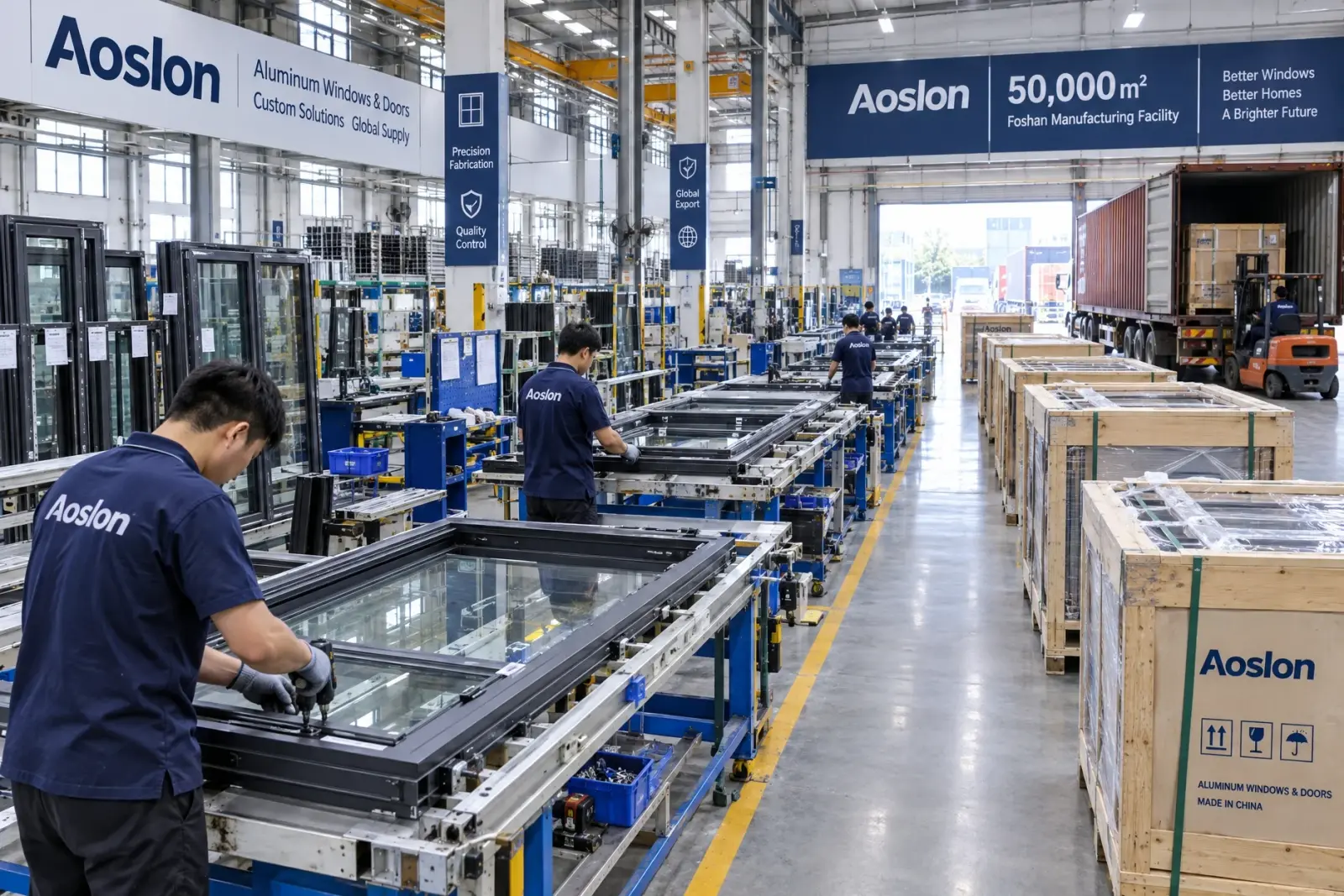
title:Aluminum window factory production line
The Short Answer: 2026 Factory Benchmark Ranges
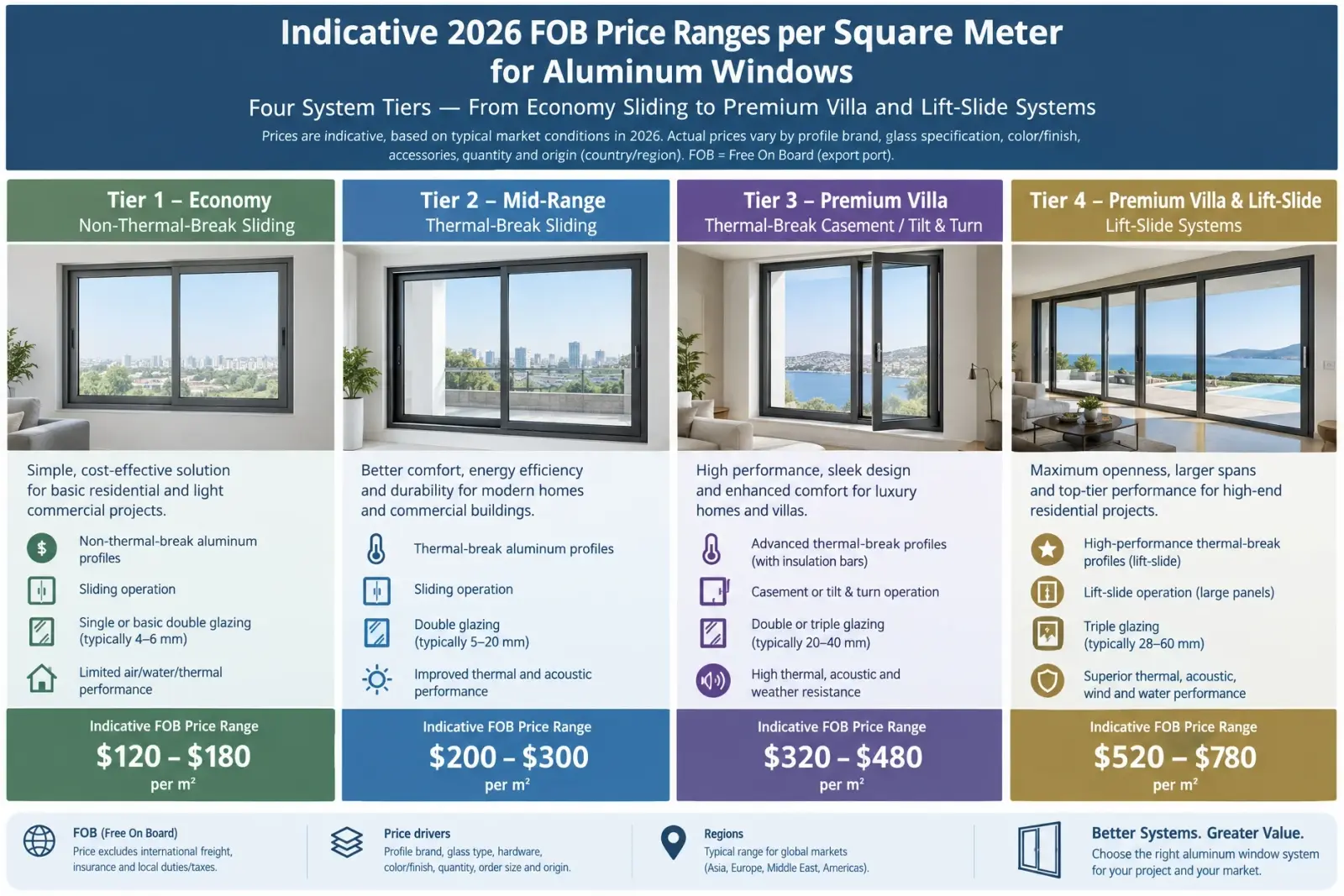
The table below reflects indicative FOB ranges observed across South China factory listings in 2026, organized the way we organize them internally — by system tier, not by window style. Treat the ranges as a sanity check for your budget, not as a quotation.
| System tier | Typical configuration | Indicative FOB range (USD/m²) |
|---|---|---|
| Economy sliding or fixed | Non-thermal-break profile, 1.2–1.4 mm wall, clear double glazing, standard powder coat | $40–70 |
| Mid-range residential | Non-TB or entry-level TB, tempered double glazing, standard RAL finish | $65–95 |
| Thermal break casement / sliding | PA66 GF25 strip, double glazing (Low-E optional), screens optional | $80–130 |
| Premium villa / narrow frame / lift-slide | Full thermal break, Low-E + argon, triple glazing optional, imported hardware options | $130–160+ |
How to use this table: match the tier to your climate code and opening schedule first, then check any quote against the tier floor. If a quote lands well below the range for its claimed tier, the usual suspects are thinner profile walls, single glazing dressed up as “insulated”, or unbranded hardware. And remember what FOB excludes — inland freight to port is included in our FOB quotes, but ocean freight, destination duties and installation are not. For a view of how the same variables price out door by door, see our aluminum sliding door range, which shares most of the profile and glazing cost structure.
The Six Variables We Quote Against
When a drawing lands on our desk, the quotation responds to six variables. Every one of them is a specification decision the buyer controls, which is why itemized quotes matter more than headline prices.
| Variable | What changes | Typical impact on price |
|---|---|---|
| Profile wall thickness | 1.2–1.4 mm economy profiles vs 1.8–2.0 mm structural profiles for villa and high-wind projects | +$10–30/m² |
| Thermal break | PA66 GF25 polyamide strip and the wider profile it requires | +$20–50/m² |
| Glazing package | Single → double → double Low-E + argon → triple (detailed below) | See glazing table |
| Hardware | Standard Chinese multi-point systems vs imported hardware brands | +$8–25/m² |
| Surface finish | Standard RAL powder coat vs anodized, wood-grain transfer or PVDF coatings | +$3–15/m² |
| Order size | Sample and pilot lots vs full-container project lots | Usually the biggest lever after specification — full-container lots price meaningfully below sample quantities |
This table is also the fastest way to compare quotes: ask every factory to itemize against these six lines. A quote that only shows one blended number per square meter is hiding at least three of them. For buyers planning a full product line rather than a single project, our custom aluminum window systems page shows how the same tiers apply across casement, sliding and fixed formats.
Glazing: The Biggest Line Item After the Profile
Glass is where budgets are won or lost, and it is also the specification most often left vague in first inquiries. “Double glazed” can mean three different packages with three different prices, so we quote glazing as its own line.
| Glazing package | Glass weight per m² | Relative glass cost | Where it fits |
|---|---|---|---|
| Single clear 5–6 mm | ~10 kg | Baseline | Interior partitions, mild coastal climates, budget projects |
| Double clear / tempered | ~20 kg | +40–60% vs single | The export default for residential work |
| Double Low-E + argon | ~20 kg | +60–80% vs single | Heating and cooling markets, energy-code driven projects |
| Triple Low-E, double cavity | ~30 kg | +10–20% vs double | Code-driven markets such as Canada and Northern Europe |
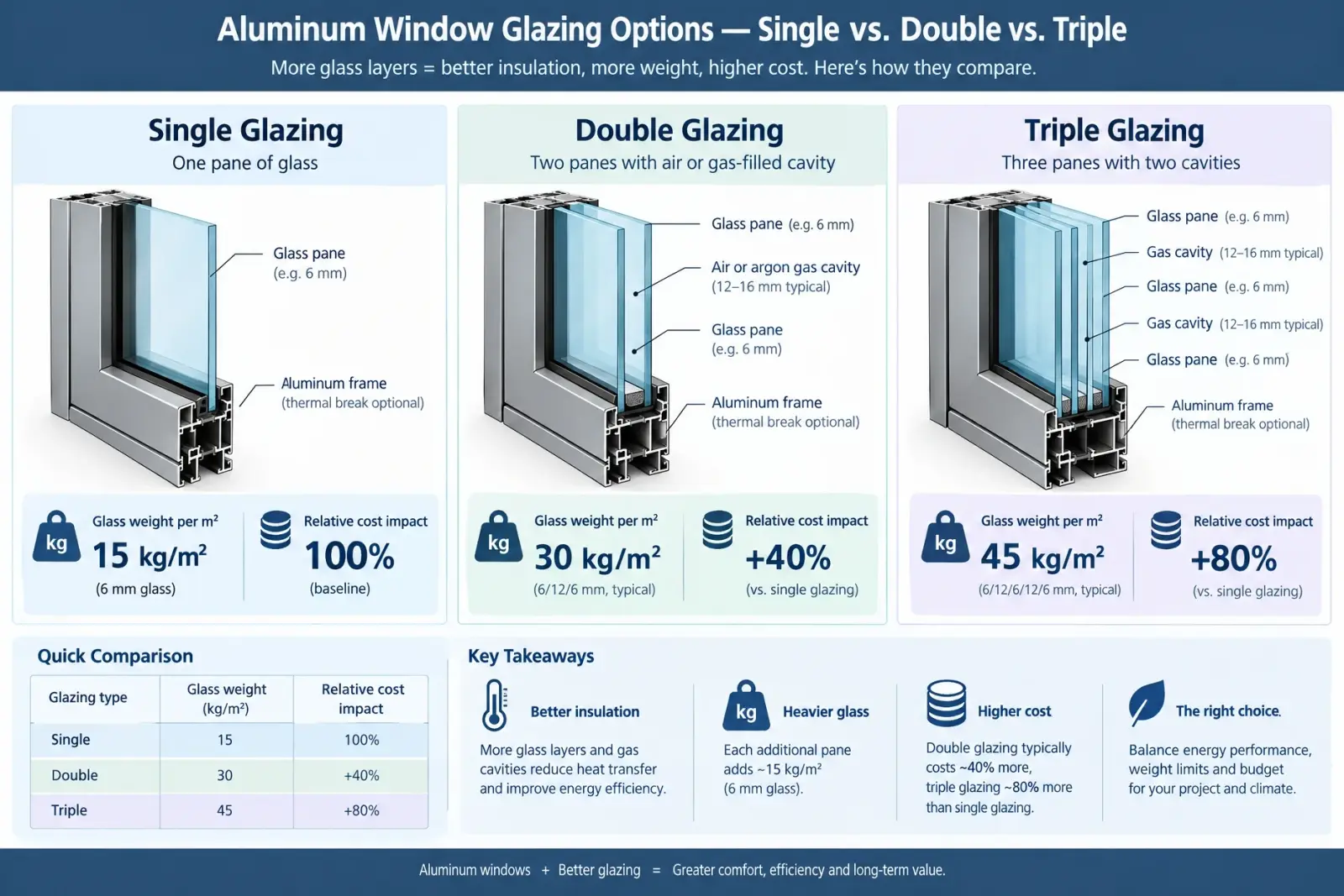
Two things in this table ripple beyond the glass itself. First, weight: at ~30 kg of glass per square meter, triple glazing demands heavier-duty sashes, hinges and rollers — which is part of why premium systems cost more even when the glass delta looks modest. Second, code direction: if your market is moving toward Low-E and argon as standard, spec it in the first RFQ rather than as a later upgrade, because retrofitting the decision mid-project re-opens the whole quotation. Our aluminum double glazed windows page shows the standard packages we ship for export residential work.
Thermal Break vs. Non-Thermal-Break: When the Premium Pays Off
The thermal break is the most misunderstood line in the quote. It is not an upgrade for its own sake — it is the difference between a window that performs in a heating or cooling climate and one that will condense, waste energy and generate warranty conversations.
| Non-thermal-break | Thermal break (PA66 GF25) | |
|---|---|---|
| Indicative 2026 FOB | $40–90/m² | $80–130+/m² |
| Best fit | Mild climates, interior applications, budget-driven projects | Heating/cooling markets, condensation control, acoustic-sensitive facades |
| Watch-outs | Interior condensation in cold snaps; energy performance below code in most Northern markets | Strip quality and width vary widely between factories — specify strip brand and width in the RFQ |
| What to verify in the quote | Profile series, wall thickness, glazing spec | All of the left column, plus thermal break strip specification and U-value data on request |
The premium pays for itself whenever your project faces a real winter or a real summer — which is why thermal break sliding and casement systems dominate our exports to Europe, North America and East Asia. See our thermal break sliding windows for the current series. If your market has no energy code and no freezing season, the non-TB tier is often the honest answer, and a good factory will tell you so.
How to Get an Accurate Factory Quote
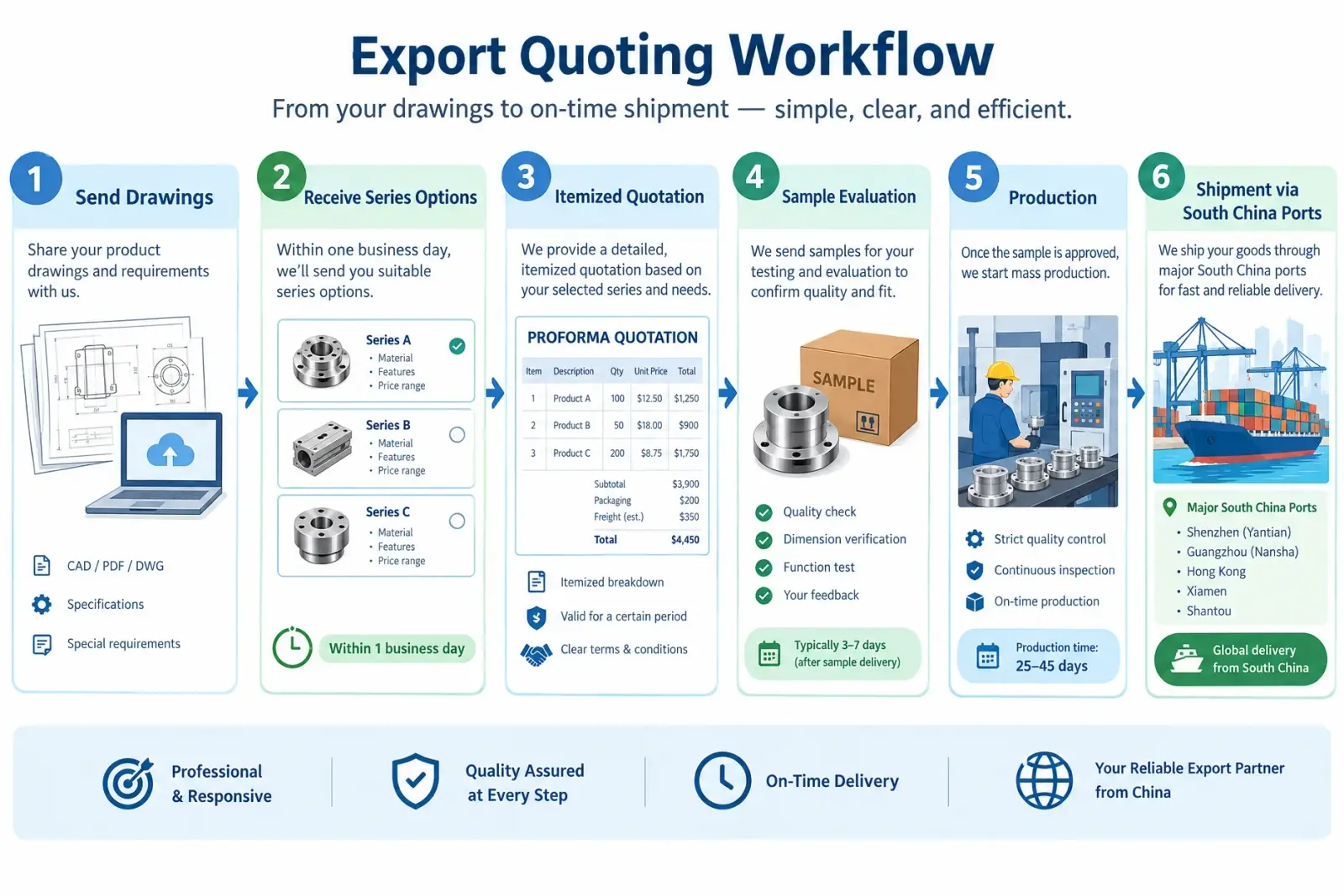
The fastest quotes come from the most complete RFQs. Send: an opening schedule with rough openings or shop drawings (PDF, DWG or DXF), glass preference, finish or RAL code if known, quantity split by window type, destination country and port, and the target delivery window. Our team reviews drawings against your market’s requirements — sizes, glass and hardware — and typically responds within one business day with series options.
What a complete factory quote should itemize: unit price per square meter by system, glazing specification, hardware brand, surface finish, screen and accessory pricing, export packing, Incoterm (we quote FOB from South China ports such as Nansha, Shekou and Yantian, CIF/CFR on request, EXW for buyers with their own forwarder), validity period, and production lead time — typically 25–45 days after deposit and drawing freeze for common finishes and glass. The same six cost variables above drive the same exercise door by door; our sliding door price breakdown walks through that in detail. For MOQ, compliance documents and lead-time planning across a full order, start from our inquiry page and attach your drawings — the form accepts up to 10 files.
Frequently Asked Questions
Do factories quote per square meter or per window?
Per square meter is the industry benchmark for comparing factories, but final quotes are itemized per opening — hardware, fabrication and packing do not scale linearly with area. Use the per-square-meter figure to benchmark, then insist on an itemized per-opening quotation before placing an order.
Is the advertised per-square-meter price FOB?
Almost always FOB a Chinese port, but confirm it. Check which Incoterm the quote assumes, whether export packing and crating are included, and whether inland freight to port is covered. A quote that looks 15% cheaper may simply be EXW.
Why is one factory’s quote half of another’s?
Ninety percent of the time it is one of the six variables above: thinner profile walls, no thermal break, lower-spec glazing, unbranded hardware, a simpler finish, or a much larger order volume. Ask both factories to itemize against the same six lines and the gap will explain itself.
What MOQ should I plan for an export order?
MOQ depends on the series, the finish and whether the lot is a dealer stock order or a project order. Sample and pilot quantities can be arranged for qualified buyers — share your target SKUs and destination market and we will confirm MOQ on the quotation rather than forcing a one-size number.
The Short Version
- Realistic 2026 FOB benchmarks: $40–70/m² economy double-glazed, $65–95/m² mid-range, $80–130/m² thermal break, $130–160+/m² premium villa and narrow-frame systems.
- Six variables move every quote: wall thickness, thermal break, glazing, hardware, finish and order size. Compare quotes line by line, not by headline price.
- Glass is the biggest line after the profile — and its weight drives hardware and sash cost. Triple glazing adds 10–20% over double, plus heavier hardware.
- Thermal break pays off in any climate with a real winter or summer; in mild markets it may be money better spent elsewhere.
Send us your opening schedule and destination port, and we will return dimensional drawings plus an itemized quotation — typically within one business day. Request your itemized quote.