Low-E glass is clear glass carrying a microscopically thin, low-emissivity coating that reflects long-wave infrared back toward the room while letting visible light through. Emissivity falls from about 0.91 on uncoated glass to roughly 0.16 for a hard coat and 0.02–0.05 for a soft coat. It is a coating, not a film, a tint or a gas fill. Performance turns on four choices: coating family, solar-control versus passive, the coated surface, and climate and orientation.
What Is Low-E Glass — and What Does Low Emissivity Actually Mean?
Start with the surface, not the marketing. Every surface exchanges heat by radiation in proportion to its temperature and emissivity, a 0–1 property. Bare clear glass radiates almost like a black body, so a single pane pulls heat from the room on a cold night. A metal-oxide coating — or silver between dielectric layers a few nanometres thick — lowers that exchange without much changing the light. A coated pane can look clear, a dark pane can carry no coating, and the coating needs the sealed cavity and frame to work.
Three numbers are not interchangeable. U-value (U-factor in North America) measures heat flow from the indoor–outdoor temperature difference, in W/m²K or Btu/h·ft²·°F; multiply by 5.678 to convert Btu to W/m²K, divide to go back. SHGC is solar heat gain, 0–1: radiation transmitted plus heat absorbed and released inward. VT is visible light transmission over roughly 380–780 nm. Low emissivity does not imply a low SHGC; separate layers set the two.
Test methods split the same way: EN 410 for visible and solar transmittance, NFRC 200 for a rated window's SHGC and VT, NFRC 100 for its U-factor, EN 673 for glass U-value, ASTM E408 or EN 12898 for emissivity. Each is a method, not a certificate.
Hard Coat vs Soft Coat Low-E: Which One Lasts in a Real Window?
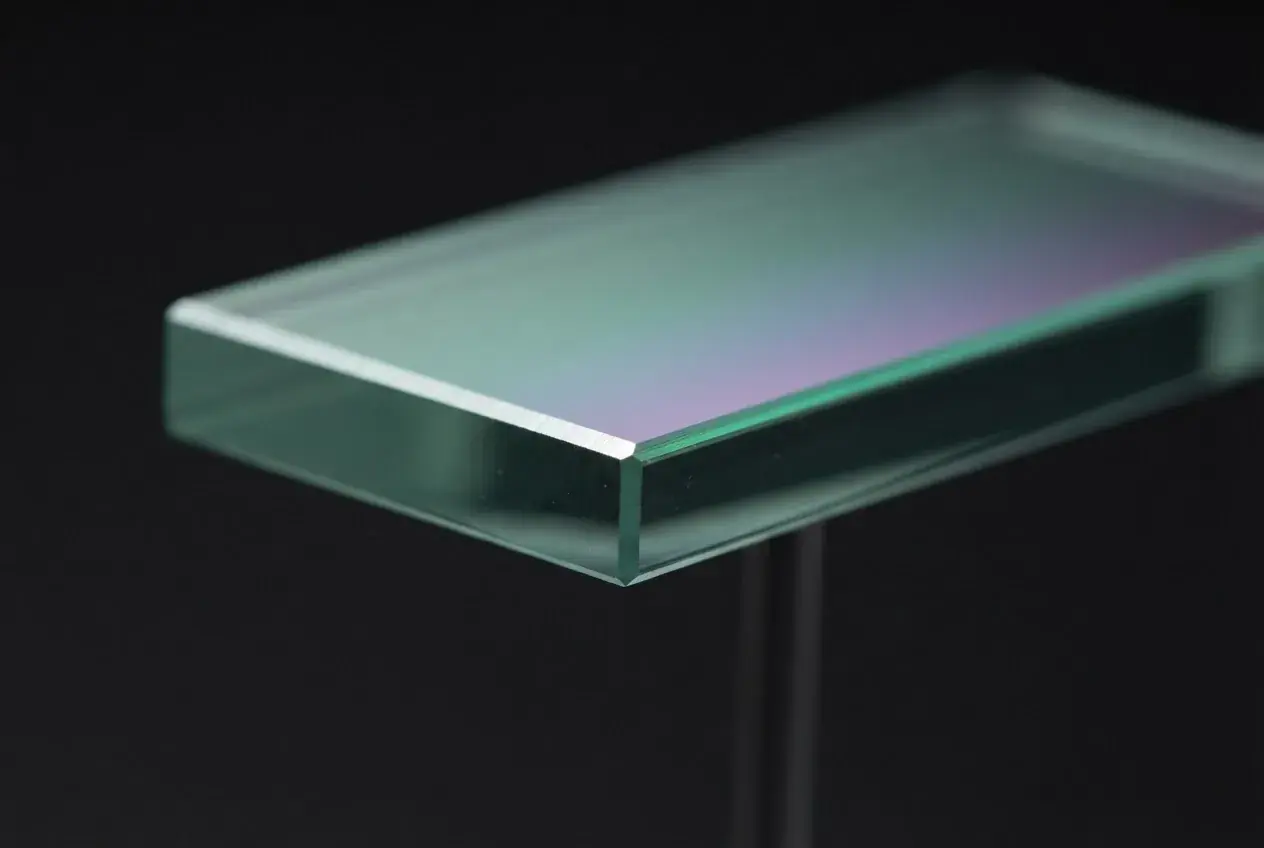
Hard coat is deposited on the float line while the glass is hot, so the oxide bonds into the surface and tolerates exposure, cutting, tempering and lamination; emissivity is higher, about 0.16. Soft coat is sputtered off-line onto cut glass, stacking silver and dielectric layers precisely, so emissivity falls to 0.02–0.05 — but the film is moisture- and abrasion-sensitive and must stay inside a sealed cavity.
The claim that soft coat "cannot be used in double glazing" is backwards: it is designed for sealed insulating units and cannot serve as an exposed monolithic pane.
Coating and product form are separate choices: Low-E arrives as a monolithic hard-coated pane, a sealed double or triple unit, or a laminated unit. Ordering "Low-E glass" without the form orders a coating, not a window.
| Item | Hard coat (on-line pyrolytic) | Soft coat (off-line MSVD) | How it is established |
|---|---|---|---|
| Where applied | Float line, before cutting | Vacuum coater, after cutting | Coating process |
| Durability | Fused oxide; tolerates handling | Fragile to moisture and abrasion; stays in the cavity | Coater handling rules |
| Emissivity | About 0.16 | 0.02–0.05 | Emissivity measurement |
| Monolithic use | Yes | No, except approved systems | Coater handling rules |
| IGU requirement | Optional | Required; edge deletion typical | Coater handling rules |
| Temper order | Yes, after coating | Temper first; temperable grades reverse this | Coater handling rules |
Which coating survives your supply chain matters as much as the numbers: hard coat tolerates site cutting and late changes, soft coat demands a factory-built unit. Our aluminum double glazed window range is quoted with either coating.
Solar Control vs Passive Low-E: How Do SHGC and Visible Light Trade Off?
Solar-control low-E rejects near-infrared energy: typical published SHGC 0.15–0.30 with VT roughly 35–65%. Passive low-E admits solar heat — SHGC about 0.50–0.75 and VT 60–80%, the top of that band near SHGC 0.7 and VT 80% — while reflecting long-wave heat inward. Mid-range products sit near SHGC 0.35–0.45 and VT 65–75%.
Lower SHGC usually costs visible light. LSG (light-to-solar-gain) is VT divided by SHGC, with VT as a fraction: 0.65 ÷ 0.27 ≈ 2.4 for strong solar control, 0.79 ÷ 0.68 ≈ 1.2 passive. Higher LSG means more daylight per unit of solar heat, but it is a comparison tool, not a target: a high-LSG coating with very low VT still leaves a room dim.
| Coating family | Silver layers | Typical SHGC | Typical VT | LSG (VT ÷ SHGC) | Where it fits |
|---|---|---|---|---|---|
| Solar control, 4 silver | 4 | 0.15–0.25 | 35–50% | 2.0–2.4 | Hot, high glare, west/east |
| Solar control, 3 silver | 3 | 0.18–0.30 | 40–65% | 2.1–2.4 | Hot to mixed, large glazing |
| Mid-range, double silver | 2 | 0.35–0.45 | 65–75% | 1.6–1.9 | Mixed and temperate |
| Passive, single silver | 1 | 0.50–0.75 | 60–80% | 1.1–1.3 | Heating-dominated, south |
Which Low-E Glass Windows Work in Hot, Cold and Mixed Climates?
Climate sets the priority. Cooling-dominated buildings push SHGC to roughly 0.20–0.30 and accept the daylight loss; heating-dominated buildings prioritise a low whole-window U-value and can afford a higher SHGC on south glass. Mixed climates need a middle band and a facade-by-facade decision; west and east take low-angle sun and want the lowest SHGC.
Surfaces run from outside: #1 outer face, #2 its cavity face, #3 the inner pane's cavity face, #4 the room side. Solar control works best on #2; passive on #3, reflecting heat back inside.
Compliance is separate. IECC and ASHRAE 90.1 set maximum whole-window U-factor and SHGC by climate zone, and the adopted edition decides the limits. That value is not glass-centre Ug: frame, thermal break, spacer, sash and installation all sit in the heat path, which is why EN ISO 10077-1/2 and NFRC 100 rate the whole product.
In hot climates the frame matters as much as the glass: the thermal-break sliding window range pairs a low-SHGC unit with a broken profile, since an unbroken aluminum frame can dominate whole-window U.
| Climate | SHGC design band | Whole-window U band, W/m²K | Coating type | Coating surface (double) | Main risk |
|---|---|---|---|---|---|
| Hot-humid | 0.20–0.30 | 1.8–2.6 | Solar control | #2 | Solar gain, glare, fading |
| Hot-dry | 0.20–0.30 | 1.8–2.6 | Solar control | #2 | Glare, thermal stress |
| Mixed | 0.30–0.45 | 1.4–2.2 | Mid-range | #2 | West overheating, heat loss |
| Cold | 0.40–0.60 | 1.0–1.6 | Passive or mid-range | #3 | Condensation, comfort |
| Very cold | 0.50–0.68 (south) | 0.8–1.2 | Passive | #3 | Condensation, ice, bridging |
Is Argon Filling or Triple Glazing Worth the Extra Money?
Argon is the cheapest upgrade: its conductivity is about two-thirds that of air, so filling the cavity displaces a better conductor. In a 3/13/3 double unit, glass-centre U falls from roughly 1.6–1.8 W/m²K with air to about 1.35–1.50 with 90% argon — a gain of 0.25–0.3 W/m²K that lasts only while the gas stays in.
Krypton suits narrow cavities but costs more and is rarely justified at 12–16 mm. Triple units are quoted on two bases, and mixing them is the commonest arithmetic error in glazing comparisons: glass-centre values for a two-coat argon triple sit around 0.5–0.8 W/m²K, the whole-window figure near 0.8–1.2. Hold one basis across every quote.
Cost is where most guides go quiet; the honest answer is a ranking, not a percentage. On the same frame and size the coating is the smallest increment, argon next, and double-to-triple the largest step: it adds a pane, cavity, spacer and frame depth, and a third pane alone adds about 50% to the glass weight. Ask for the delta itemised on your own size and frame.
Triple glazing pays back when the climate is severe, energy expensive, the glazing large and the frame designed for the load. It usually does not when the climate is mild, energy is cheap, windows are small, or the building already overheats. Argon and a warm-edge spacer come first: they cost little and protect the cavity you paid for.
| Build | Glass-centre Ug, W/m²K | Change vs clear double (2.7 W/m²K) | How it is established |
|---|---|---|---|
| Single pane, clear | 5.6–5.8 | Roughly double the loss | Calculated, EN 673 basis |
| Single pane, hard-coat low-E | 3.5–4.0 | 30–48% higher loss | Calculated, EN 673 basis |
| Clear double, air | 2.6–2.8 | Baseline | Typical range |
| Low-E double, air | 1.65–1.74 | About 35–40% lower | Typical published range |
| Low-E double, 90% argon | 1.35–1.50 | About 45–50% lower | Typical published range |
| Triple, two low-E, 90% argon | 0.5–0.8 | About 70–80% lower | Typical published range |
How Do You Write a Low-E Glass Specification the Factory Can Quote?
A quotation is comparable only when the glass build is as precise as the frame. "Low-E glass" is a category, not a specification: the factory needs glass type and thickness per pane, coating and surface, cavity and gas, spacer and seal, performance values with their test basis, and the reports.
Surface numbering is most often missing. Write "#2" or "#3", not "inside"; the factory cannot infer the coated face, and in triple glazing the numbering runs to #6.
A complete line reads like this:
- Glass: 3 mm clear + Low-E soft coat on surface #2 + 13 mm argon (90%) + 3 mm clear, warm-edge spacer.
- Glass performance: Ug 1.35–1.40 W/m²K glass-centre (EN 673; NFRC 100 centre-of-glazing); SHGC 0.25–0.30, VT 55–65% (EN 410).
- Whole-window performance: Uw and SHGC to NFRC 100 and NFRC 200 for the frame and size supplied — not for a bare IGU.
- Durability: IGU tested to ASTM E2190 or EN 1279, report supplied with the order.
That line is a benchmark, not a production recommendation: 3 mm is the published basis, while aluminum windows commonly use 5–6 mm, and a 6 mm build must be recalculated.
Write one glass line per window type; villa projects often mix fixed, sliding and casement frames, and the villa aluminum window systems page shows the configurations. For export orders, Aoslon quotes FOB, CIF, CFR or EXW; lead time is typically 25–45 days after drawing approval, and minimum order depends on the series.
Can Low-E Glass Be Tempered, Laminated or Used in a Single Pane?
Hard coat can be tempered, laminated and used as a single pane. Soft coat must be sealed inside an insulating unit or used in a coater-approved exposed system. That is the real limitation behind the "not for double glazing" myth: soft coat is built for sealed units — double, triple and laminated alike — not exposed monolithic glazing.
Standard soft coat is deposited after tempering, and only temperable grades may be coated first; soft-coated glass follows a coater-approved laminate schedule.
Single-pane low-E is possible with hard coat but is not an insulating solution: a 6 mm pane still sits around 3.5–4.0 W/m²K at the centre, roughly 1.3–1.5 times the loss of a clear double-glazed unit at about 2.7 W/m²K, because there is no gas cavity. The coating cuts radiant exchange; it cannot replace the cavity. In laminated units the interlayer adds safety and acoustics, not thermal resistance, and the coating position follows the coater's approval: #2 in a laminated IGU is often a PVB interface, so "#2 or #3" is not by itself safe.
How Do You Verify a Supplier's Low-E Glass Claim Before You Pay?
Ask for four reports tied to your build: emissivity (ASTM E408 or EN 12898), glass U-value (EN 673, or the centre-of-glazing value from an NFRC 100 simulation), optical values (EN 410 for glass, NFRC 200 for a rated window), and IGU durability (ASTM E2190 or EN 1279). A certificate that names none of these, or a different build, is not evidence.
The NFRC label rates a complete window — frame, glass, spacer, operator, size — not a pane. The same IGU in a different frame gives a different U-factor and SHGC; a glass datasheet presented as an NFRC rating is misused. For a code submission, request the whole-window rating for the product supplied.
At sample stage, check the coating is on the cavity face, the edge deletion is even, and there are no scratches, haze or patchy iridescence. Then reconcile the report's build, surface, gas and spacer against the order line; any mismatch needs a revised report or written deviation.
Frequently Asked Questions
What is the difference between Low-E glass and tinted glass?
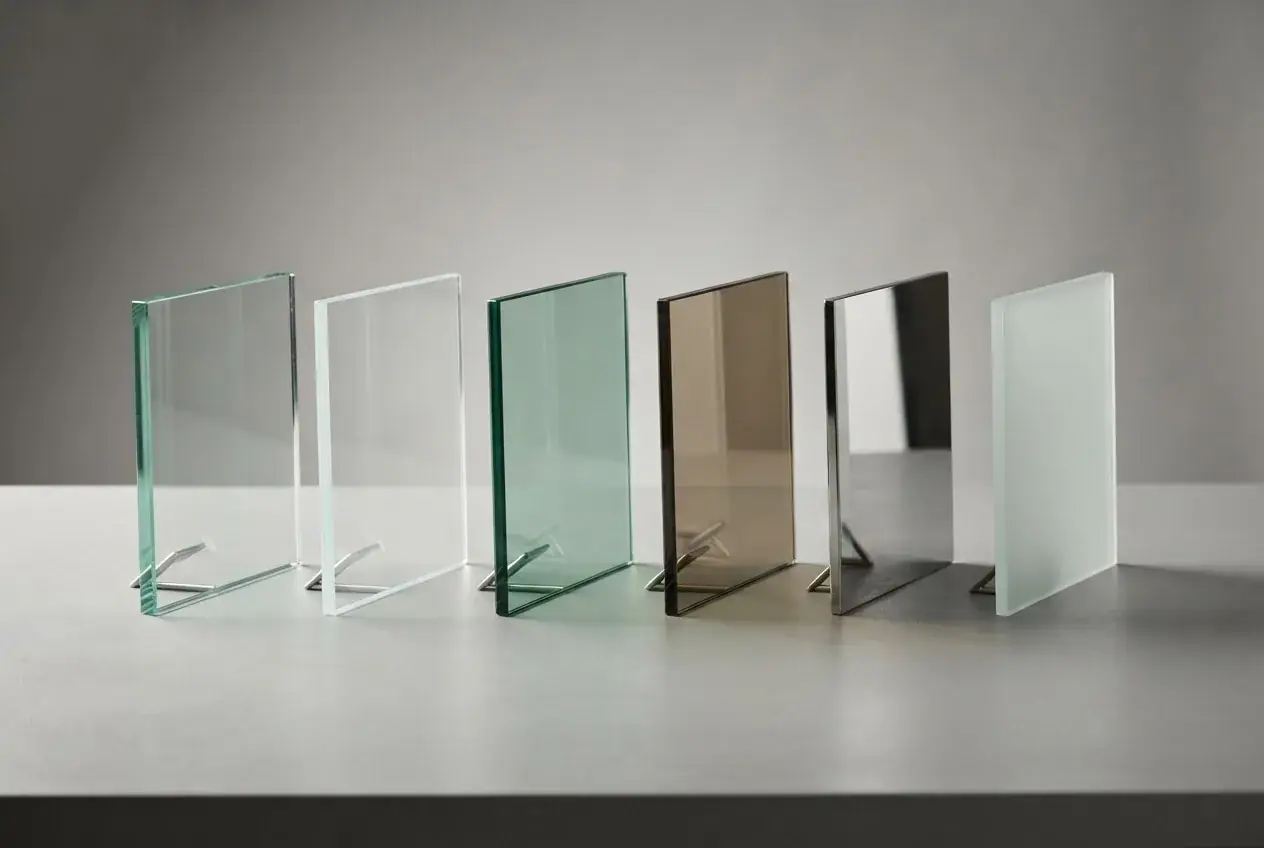
Tinted glass absorbs solar energy through pigments or metallic oxides in the body, darkening the view. Low-E glass carries a coating that reflects long-wave infrared; it can be nearly clear, and its job is radiant heat control. A product can be both, but the functions are separate.
Why do some suppliers say soft coat Low-E cannot be used in double glazing?
The claim confuses double glazing with monolithic use. Soft coat is made for sealed units; it cannot tolerate weather, cleaning and handling as a single pane. "We cannot edge-delete or guarantee the seal" is a process limitation, not a rule about double glazing.
Which surface should the Low-E coating be on — 2 or 3?
For solar control, surface #2 — the cavity face of the outer pane — intercepts radiation before it crosses the cavity. For passive low-E in a heating climate, surface #3 reflects interior heat back inside. The answer depends on coating type and climate; in a laminated unit, on the coater's approval.
How much does Low-E glass add to the price of a window?
There is no single percentage; the increment depends on coating family, panes, gas, spacer, size and volume. What holds is the ranking: on the same frame and size the coating is the smallest step, argon next, double-to-triple the largest. Ask for the difference itemised on your own build; a brochure average is not comparable.
How do I know if my windows really have Low-E glass?
Start with an emissivity report and a U/SHGC report naming the glass build, coating surface and gas fill. On the sample, check the coating is on the cavity face and the edge deletion is even. A colour shift at an angle is a clue, not proof; a laboratory test is the reliable check.