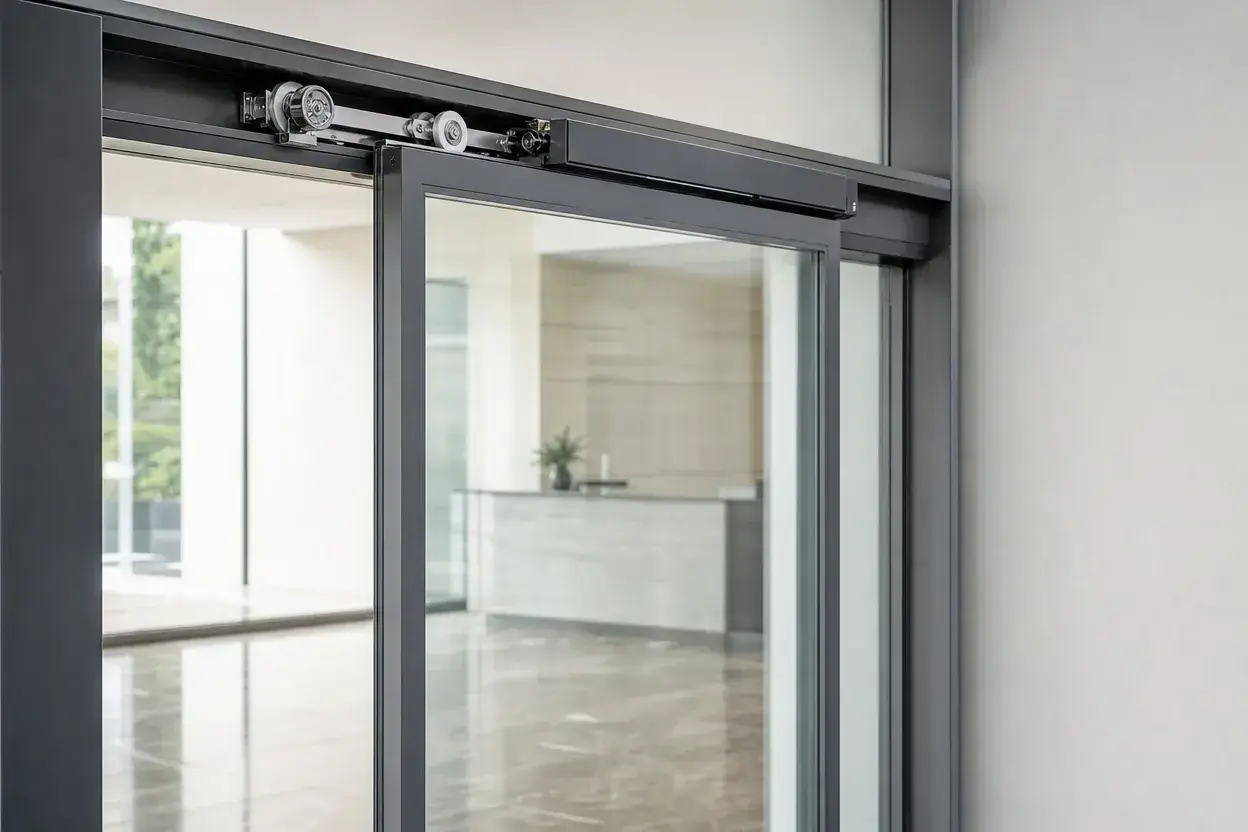
Short answer: the best self-closing sliding door solutions for B2B projects are engineered combinations of panel, track, rollers, closer or operator, and safety controls. Plan around 60–250 kg per panel, 20–80 N closing force, 50,000–100,000+ test cycles, and a 100–300 mm soft-close travel zone. Choose a manual gravity, spring or damper system for lighter panels; choose motorized auto-close when panels exceed roughly 120 kg or traffic exceeds 100 cycles per day. The correct solution is proven by panel weight, closing force, cycle data and local safety requirements, not by a generic “soft-close” label.
60–250 kg Typical per-panel planning range for commercial sliding doors 20–80 N Common closing-force planning band; local code limits apply 50k–100k+ Test cycles for rollers, tracks, closers and operators 100–300 mm Typical soft-close or soft-brake travel before final latch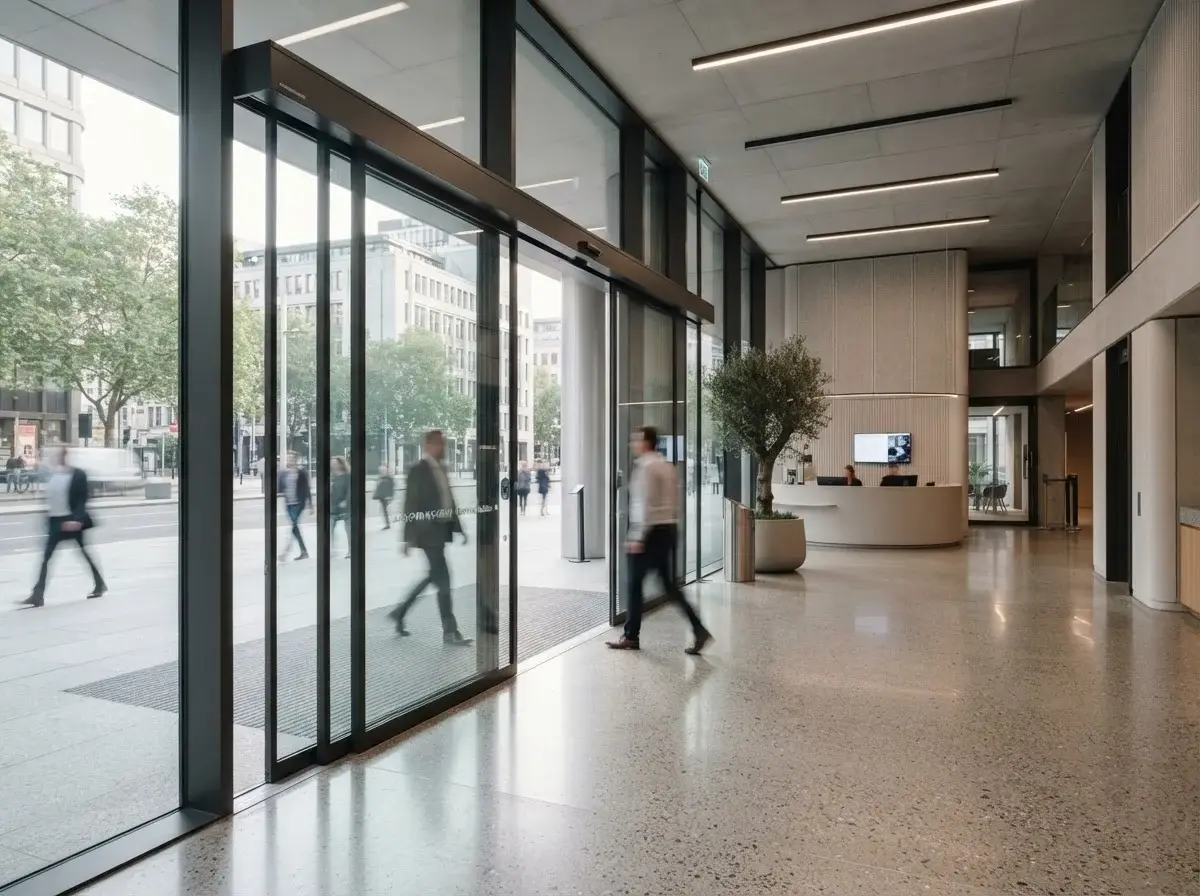
Which are the best self-closing sliding door solutions for B2B projects?
There are five practical self-closing approaches for commercial sliding doors. They are not interchangeable accessories: each one has a different panel-weight limit, maintenance requirement and safety implication. The comparison below helps contractors, architects and procurement teams select by project condition instead of by catalogue wording.
| Solution | How it works | Best for | Avoid when | Evidence to request |
|---|---|---|---|---|
| Gravity / inclined track | Track slope uses gravity to return the panel toward the closed position | Light to medium panels with manual operation | Heavy panels, high traffic or precise force control | Track slope, panel-weight limit and closing-force test |
| Spring / cable return | A spring or cable pulls the panel toward the closed position | Medium panels, service doors and controlled closures | Openings with no access for tension adjustment | Force curve, adjustment range and spring-cycle data |
| Soft-close damper | Hydraulic or mechanical damping controls the final travel zone | Heavy glass, hospitality and premium commercial openings | A project expecting the damper alone to close the door | Damper travel, closing-speed curve and cycle test |
| Motorized auto-close | A motor closes the panel using timers, sensors and programmed force | High-traffic retail, healthcare, logistics and commercial openings | Projects without reliable power or maintenance capability | Operator datasheet, sensor list, force settings and safety scope |
| Hold-open with release | The panel is held open and released by a signal or alarm | Fire or smoke compartmentation where permitted | Openings where hold-open is prohibited or alarm integration is unavailable | Release-device listing, wiring diagram and local fire approval |
Suitability must be confirmed against final panel weight, dimensions, daily traffic, local code and the selected closer or operator.
Soft-close is not the same as self-close. A damper controls the final 100–300 mm of travel; gravity, a spring, cable or motor must still return the panel to the closed position. The best self-closing sliding door solutions combine both functions in one coordinated system.Technical parameters to lock before you approve a quotation
Use the following matrix in pre-qualification. It helps architects, contractors and procurement teams compare suppliers against one technical basis instead of accepting a generic “self-closing” or “soft-close” claim.
| Parameter | Planning range | Why it matters | Evidence to request |
|---|---|---|---|
| Panel weight per leaf | 60–250 kg | Determines roller class, track profile and closing mechanism | Calculated panel weight with glass, frame and hardware |
| Closing force | 20–80 N | Affects accessibility, safety and reliable latching | Force test and local accessibility requirements |
| Soft-close travel | 100–300 mm | Controls noise, impact and final sealing | Damper drawing, speed curve and cycle data |
| Motorized closing speed | 0.15–0.50 m/s | Balances traffic speed, safety and noise | Operator setup, sensor logic and safety compliance |
| Cycle life | 50k–100k+ | Defines maintenance interval and total cost of ownership | Roller, track, spring and operator cycle statements |
| Thermal performance | 1.2–2.5 W/m²K | Affects HVAC load, condensation and comfort | U-value calculation for the complete door assembly |
| Air, water and wind | Project-specific | Determines weather sealing and structural suitability | EN 12207, EN 12208 and EN 12210 test information where applicable |
| Safety and control | Manual or power-operated | Protects users and determines commissioning requirements | EN 16005 or ANSI/BHMA A156.10 scope, control diagram and sensor list |
Ranges are indicative planning benchmarks, not product guarantees. Verify applicability through CEN, ISO, ANSI, ADA or the local authority having jurisdiction.
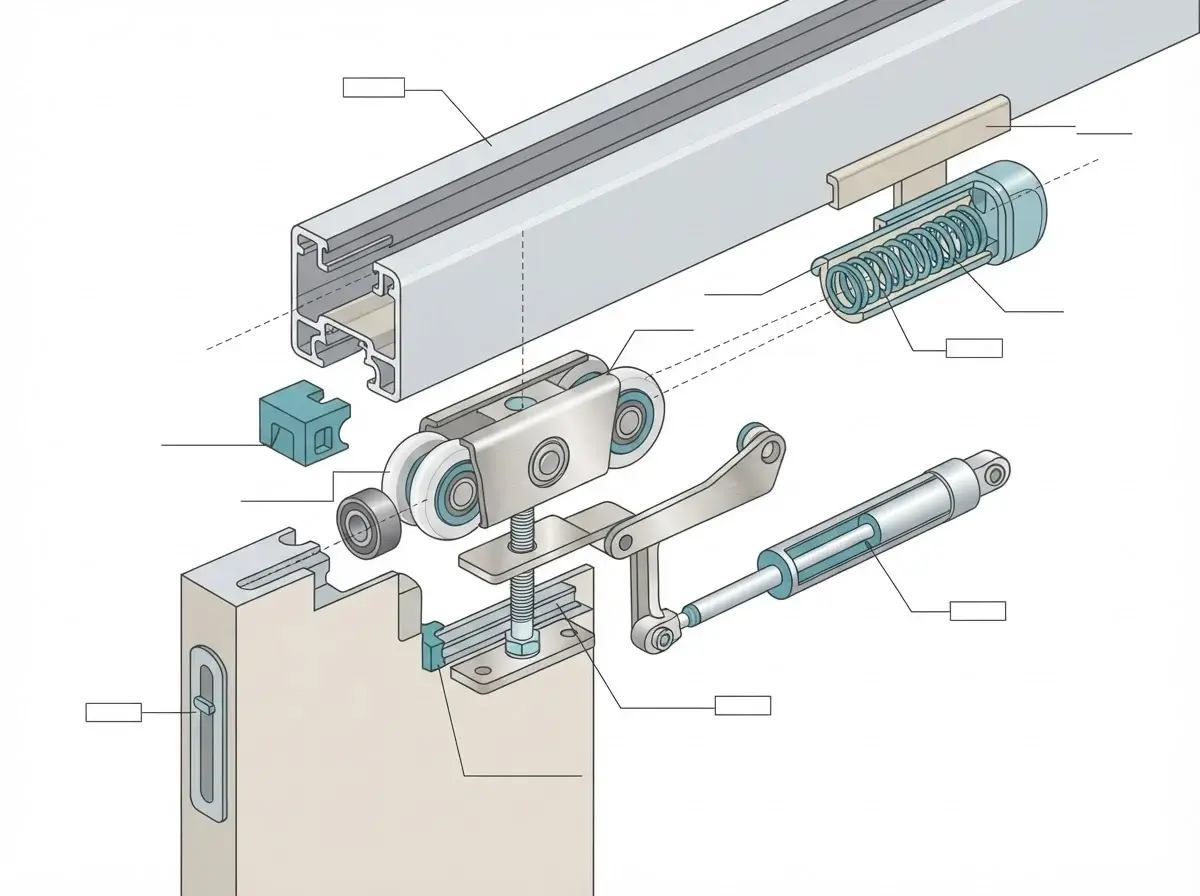
Manual or motorized self-closing: how to choose
- Manual soft-close is usually suitable for 60–120 kg panels. It works best where traffic is controlled and power is unavailable.
- Spring or cable return needs an accessible adjustment point. Confirm the force range, spring life and maintenance interval.
- Motorized auto-close is preferred for 120–250 kg panels and high-cycle openings. Confirm sensor logic, emergency release and force settings.
- Soft-close is not the same as self-close. The damper controls the final 100–300 mm; another mechanism or motor must return the panel to the closed position.
- Check accessibility before specifying force. In the US, ADA guidance is commonly referenced, while EN 16005 may apply to power-operated doors. Applicability must be verified for the project.
B2B decision pain points: what each stakeholder needs before approval
A self-closing sliding door is approved by different people for different reasons. The supplier response should address the risk behind each role’s decision, not send the same catalogue page to the whole project team.
| Decision role | Hidden risk | Proof required | Aoslon support |
|---|---|---|---|
| Architect / designer | A visible track or closer that conflicts with the facade design | Section drawing, finish samples and concealed-hardware options | Configuration review against design intent |
| General contractor | Wrong opening tolerance, track height or floor-guide detail | Shop drawing, installation sequence and interface checklist | Drawing review against the opening schedule |
| Facility manager | Roller wear, failed soft-close and unplanned maintenance | Cycle life, adjustment points, spare parts and O&M guide | Component list and maintenance schedule |
| Procurement manager | Incomplete scope and unclear exclusions | Itemized quote, Incoterms, packing and production schedule | Transparent line-item quotation |
| Developer / owner | Repeated failure across multiple buildings | Warranty, test evidence and repeat-production controls | Standardized system with project-level configuration |
| Dealer / installer | Assembly error, missing parts and difficult adjustment | Packing list, installation guide, labels and technical support | Export packing, QC record and installation documentation |
Aoslon support scope is confirmed against the final project specification and contract. Verify local electrical, accessibility and fire-safety responsibilities before ordering.

How to specify best self-closing sliding door solutions in 7 RFQ lines
A complete RFQ gives the factory enough information to confirm the mechanism, hardware and safety scope. It also makes quotations easier to compare across suppliers.
| RFQ line | Required information | Why it matters | Document to request |
|---|---|---|---|
| 1. Opening and panel | Width, height, number of leaves, clear opening and stacking direction | Determines track length, roller position and closing travel | Dimensioned shop drawing |
| 2. Panel weight | Frame, glass, hardware and estimated weight per leaf | Prevents roller and closer overload | Weight calculation and roller load statement |
| 3. Closing mechanism | Gravity, spring, damper, motorized or hold-open release | Defines closing behavior and maintenance model | Mechanism drawing and adjustment guide |
| 4. Closing force | Required force, accessibility limit and final latch condition | Affects safe operation and reliable sealing | Force test and local code statement |
| 5. Hardware and track | Roller class, track profile, floor guide and material finish | Determines durability, noise and alignment | Component list and cycle-test data |
| 6. Safety and controls | Sensor type, timer, emergency release, hold-open and alarm interface | Prevents injury and commissioning failure | Control diagram and compliance scope |
| 7. Performance and documents | U-value, wind load, air and water tightness, finish and packing | Supports engineering approval and project handover | Test report, warranty and O&M documents |
Send the opening schedule and drawings before the final quotation. Missing dimensions or performance targets are the main reason for repeated RFQ revisions.
How Aoslon reduces risk in self-closing sliding door projects
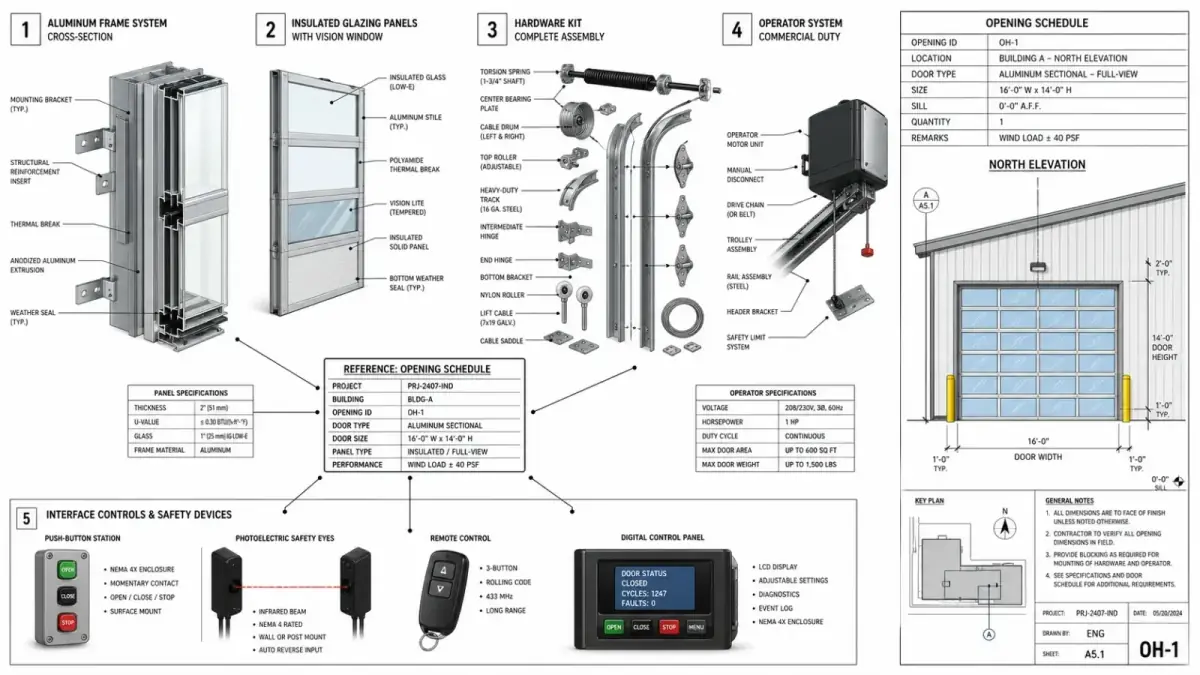
Aoslon supports B2B buyers by reviewing the opening schedule, panel weight, closing mechanism, hardware and safety scope before quotation. This reduces the risk of selecting a system that cannot achieve the required force, cycle life or sealing performance.
- Engineering review. Check opening dimensions, panel weight, track span and installation interface.
- Mechanism selection. Compare gravity, spring, damper, motorized and hold-open solutions against project conditions.
- Component documentation. Provide drawings, hardware schedules, cycle information and maintenance requirements.
- Export packing and QC. Confirm labeling, protection, packing list and inspection before shipment.
- Project support. Coordinate with dealers, contractors and design teams during quotation and technical approval.
Conclusion: choose the solution, not the label
The best self-closing sliding door solutions are not the ones with the longest feature list. They are the ones that can prove panel-weight capacity, closing force, soft-close travel, cycle life and safety compliance for the actual opening.
For a 60–120 kg manual door, a coordinated spring or gravity return with soft-close damper may be sufficient. For a 120–250 kg commercial opening or a high-traffic environment, motorized auto-close with documented safety controls is usually the more reliable path.
Send your opening schedule for a self-closing sliding door review
Include dimensions, panel weight, daily cycles, destination country, closing-force target and safety requirements. Aoslon will confirm the mechanism, hardware and quotation basis.
Request a Self-Closing Sliding Door Quote
Preguntas frecuentes
- What are the best self-closing sliding door solutions for commercial projects?
- The best choice depends on panel weight and traffic. Gravity, spring or cable return suits lighter manual doors; a soft-close damper improves the final 100–300 mm; motorized auto-close is usually preferred for panels above 120 kg or high-cycle commercial openings. Fire-rated hold-open with release is separate and must meet local fire approval.
- How much panel weight can a self-closing sliding door handle?
- Commercial sliding doors commonly range from 60–250 kg per panel, with larger systems exceeding that. The roller class, track profile and closing mechanism must be selected for the calculated panel weight plus glass and hardware.
- What closing force should a self-closing sliding door use?
- A planning band of 20–80 N covers many systems, but the final value must satisfy local accessibility and safety requirements. In the US, ADA guidance is often referenced; for power-operated doors, EN 16005 or ANSI/BHMA A156.10 may apply.
- Is soft-close the same as self-closing?
- No. Soft-close controls the final travel and impact, usually the last 100–300 mm. A gravity track, spring, cable or motor must still return the panel to the closed position.
- Are motorized self-closing sliding doors better for high traffic?
- Usually yes. Motorized auto-close provides repeatable force, adjustable speed and sensor integration, which is difficult to achieve with a manual return spring. Confirm emergency release, obstruction detection, power failure behavior and maintenance access.
- What cycle life should be specified for commercial sliding door hardware?
- Many commercial projects specify 50,000–100,000+ cycles for rollers, tracks and closers. Match the figure to daily traffic, expected service life and maintenance capability, then request component-level cycle data.
- What documents should be requested before ordering?
- Request shop drawings, panel-weight calculation, roller and track specifications, closing-force information, safety-control diagrams, test reports, packing list, warranty terms and operation and maintenance instructions.
- How do I compare self-closing sliding door suppliers fairly?
- Issue one written specification with panel weight, closing force, soft-close travel, cycle life, safety requirements and document scope. Require each supplier to submit an itemized quote, exclusions, drawings and production schedule. Compare the complete technical and commercial package, not only the unit price.
Published 23 September 2026 · AOSLON · Foshan, Guangdong, China. Planning ranges are indicative industry benchmarks for B2B specification and quote review. They are not Aoslon product guarantees. Final performance and pricing are confirmed against approved drawings, project conditions and applicable standards.